

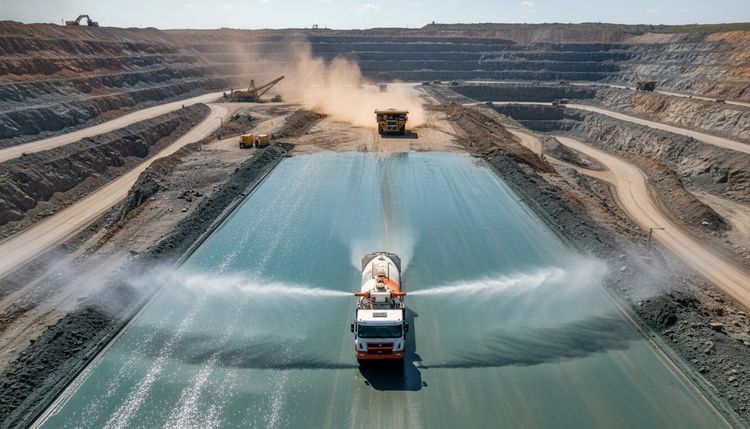
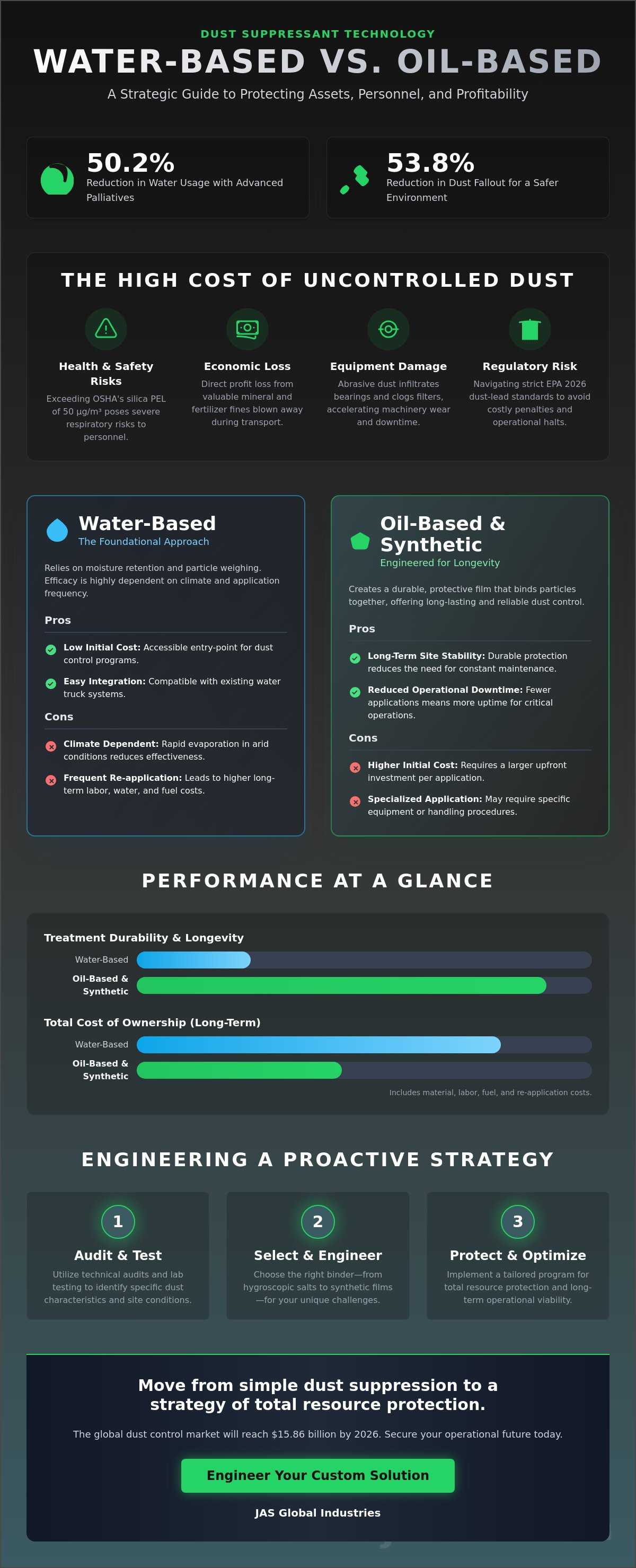
A study by du Plessis demonstrated that switching from water-only methods to advanced palliatives can slash water usage by 50.2% and reduce dust fallout by 53.8%. In a global market projected to hit $15.86 billion by 2026, the choice between water-based vs oil-based dust suppressants is no longer a secondary concern; it's a core pillar of industrial stability. You likely face the daily challenge of protecting your workforce while meeting the EPA's strict 2026 dust-lead hazard standards. High product loss during transport and the constant cycle of re-application costs can erode your operational margins quickly.
This selection guide provides the technical clarity needed to maximize mineral recovery and ensure long-term environmental security. You'll discover how to balance chemical longevity with regulatory compliance, specifically regarding the OSHA silica PEL of 50 micrograms per cubic meter. We will detail the performance profiles of leading technologies so you can reduce downtime and maintain a reliable, sustainable infrastructure. By understanding these critical differences, you can move from simple logistics to a strategy of total resource protection.
Key Takeaways
- Identify how proper suppressant selection acts as a safeguard for your assets by minimizing the loss of high-value mineral and fertilizer fines.
- Analyze the operational trade-offs of water-based vs oil-based dust suppressants to balance immediate application costs with long-term site stability.
- Understand the technical mechanics behind hygroscopic salts and synthetic films to choose the right binder for your specific transport and storage conditions.
- Learn to reduce operational downtime by aligning application frequency with the durable protection offered by engineered synthetic and bio-based oils.
- Discover the role of technical audits and laboratory testing in moving from generic chemical applications to high-performance, tailored dust management programs.
The Industrial Imperative: Why Dust Suppressant Selection Matters
Dust control is a fundamental requirement for the stability of global infrastructure. We define dust suppressants as specialized chemical agents engineered to bind surface particles, effectively preventing them from becoming airborne. For decades, many facilities relied on simple water application. However, the industry is moving toward long-term surface stabilization. Choosing between water-based vs oil-based dust suppressants is a strategic decision that affects both environmental compliance and operational efficiency. Effective fugitive dust control methods ensure that critical materials remain where they belong: in the production cycle. This shift from temporary wetting to durable binding is essential for maintaining the integrity of bulk materials.
Protecting Resources and Personnel
The protection of human life and high-value equipment is paramount. Airborne particles, particularly respirable crystalline silica and fine fertilizer dust, pose significant health risks. Exposure can lead to chronic respiratory issues, making compliance with the OSHA PEL of 50 µg/m³ a non-negotiable standard. Beyond health, dust acts as an abrasive. It infiltrates bearings, clogs filters, and accelerates machinery wear. By applying advanced chemical additives, operators create a safer work environment with improved visibility. This isn't just about safety; it's about the reliable continuity of global resource extraction and the well-being of the communities surrounding industrial sites.
Economic Impact of Dust Control
Product loss is often an invisible drain on profitability. When fertilizer or mineral fines blow away during transport or storage, they represent a direct hit to the bottom line. These fines are often the most valuable part of the product, yet they're the easiest to lose. Dust suppression acts as a vital guardian of industrial yields by locking these particles in place.
- Resource Recovery: Maximizing the volume of minerals or fertilizers that reach the final customer.
- Operational Savings: Reducing the frequency of road maintenance and equipment cleaning.
- Regulatory Security: Navigating the 2026 landscape of global VOC and environmental runoff standards without facing costly penalties.
In 2026, navigating global environmental standards requires a shift in perspective. Transitioning from a reactive watering approach to a proactive chemical management plan allows companies to maximize recovery. Whether you're evaluating water-based vs oil-based dust suppressants, the goal remains the same: transforming a potential hazard into a stabilized, profitable asset. By treating dust control as a process optimization rather than a commodity purchase, you ensure the long-term viability of your operation.
Water-Based Dust Suppressants: Mechanics and Applications
Water-based solutions represent the foundational layer of modern dust control. These technologies primarily rely on moisture retention and particle weighing to keep fines grounded. Choosing between water-based vs oil-based dust suppressants requires a focus on immediate investment versus long-term site stability. The former stands out for its low initial cost and immediate ease of integration into existing water-truck systems. They're non-flammable, easy to store, and generally safer for immediate handling by personnel. However, their efficacy is intrinsically tied to the local climate. In arid regions, high evaporation rates necessitate frequent re-application cycles. This constant maintenance can lead to higher long-term labor and fuel costs compared to film-forming alternatives.
For a deeper technical breakdown of these categories, the USDA's Dust Palliative Selection and Application Guide provides extensive data on organic nonpetroleum adjuvants. These water-based systems are ideal for short-term stockpiles, high-traffic temporary roads, or humid environments where natural moisture assists the chemical's longevity.
The Role of Specialized Surfactants
Water naturally possesses high surface tension. This often causes it to bead on the surface of "hydrophobic" dust, such as coal or specific mineral ores, rather than penetrating the material. Specialized surfactants solve this by reducing the surface tension. This allows the solution to saturate the dust particles more effectively, increasing their mass and preventing them from becoming airborne. In mining operations, these additives must be carefully selected to ensure they don't interfere with downstream mineral flotation processes. Tailoring these formulas ensures that your fertilizer dust suppressants or mining aids remain compatible with your specific chemical circuit, protecting both the environment and your production yields.
Hygroscopic Salts and Humectants
Hygroscopic salts, such as magnesium chloride and calcium chloride, act as powerful humectants. They possess the unique ability to pull moisture directly from the atmosphere, even in relatively dry conditions. This keeps the treated surface damp for longer periods than plain water alone. When comparing the longevity of water-based vs oil-based dust suppressants, salts represent the most durable option within the water-based category. While highly effective for road stabilization, these salts introduce potential corrosion risks to industrial infrastructure and transport vehicles. Operators must balance the benefits of moisture retention with the need to protect steel structures. Additionally, managing application rates is necessary to prevent excessive groundwater runoff near treatment plants. This careful calibration is critical for maintaining environmental security and long-term operational stability.
Oil-Based and Synthetic Suppressants: Engineered for Longevity
Stability requires a physical barrier. While water-based systems rely on moisture retention, engineered palliatives create a durable, flexible crust that binds surface particles indefinitely. This mechanism is the cornerstone of long-term site security. In arid regions where evaporation occurs within minutes, the choice between water-based vs oil-based dust suppressants is determined by the physical reality of the climate. Non-evaporative binders stay in place. They don't disappear into the atmosphere. This leads to immediate operational benefits, specifically reduced water consumption and significantly lower labor costs. You stop the cycle of constant re-watering. You start a program of permanent surface stabilization.
The chemical hierarchy of these products has evolved. We've moved beyond simple petroleum applications to sophisticated synthetic and bio-based esters. These high-purity solutions act as a guardian for your materials, ensuring that fine ores and fertilizers remain cohesive during storage and transit. This engineered approach protects your yields and the environment simultaneously.
Synthetic Polymer Formulations
Advanced synthetic polymers function by creating a cross-linked matrix within the top layer of the material. This isn't just a surface coating; it's a structural reinforcement. This matrix is designed to survive the intense pressure of heavy machinery traffic and haul road vibrations. UV stability is a critical factor here. These formulations are engineered to resist degradation under intense sunlight, maintaining their binding strength for months rather than days. Additionally, their waterproof properties prevent erosion. During sudden heavy rainfall, the polymer film sheds water, keeping the road base dry and preventing the loss of high-value fines into runoff streams.
Petroleum and Natural Ester Alternatives
The industry has undergone a significant transition from "waste oil" to high-purity industrial esters and bitumen emulsions. Modern bitumen emulsions provide a heavy-duty solution for permanent haul roads, creating a surface that mimics the durability of asphalt without the same infrastructure cost. For operations focused on ethical and environmental balance, natural esters offer a biodegradable alternative that doesn't sacrifice performance. These formulations must integrate seamlessly with other process chemicals, such as fertilizer anti-caking agents, to ensure total product integrity. By selecting high-purity alternatives, you maintain compliance with global safety standards while securing the stability of your critical resources. This proactive chemical management ensures that your dust control strategy supports, rather than hinders, your overall production goals.
Comparative Analysis: Operational Longevity vs. Initial Cost
Understanding the Total Cost of Ownership (TCO) is the only way to accurately evaluate water-based vs oil-based dust suppressants. Initial chemical costs are often misleading. A true analysis must factor in labor, water consumption, and the "invisible loss" of product fines. While water-based options offer a lower entry price, their daily or weekly application cycles drain resources. In contrast, oil-based and synthetic solutions provide monthly or even yearly stability. This long-term protection reduces the need for constant maintenance and minimizes product loss during bulk handling. Reliability is built on this durability.
Equipment requirements further differentiate these strategies. Standard water trucks are common but lack the precision needed for advanced chemical application. Transitioning to specialized dosing systems ensures that mining grinding aids or suppressants are distributed at optimal rates. This precision prevents over-application and protects the chemical integrity of your materials. It's about moving from simple logistics to engineered resource protection.
Performance in Diverse Climates
Climate dictates the success of your program. In arid zones like the Middle East or Africa, evaporation makes water-based solutions a tactical, temporary fix rather than a strategic asset. The choice of water-based vs oil-based dust suppressants in these regions usually favors non-evaporative binders that withstand intense heat. Conversely, high-humidity regions allow operators to leverage atmospheric moisture using hygroscopic agents. For winter operations, selecting suppressants with low pour points is essential to prevent freezing within the dosing equipment, ensuring the reliable continuity of site safety.
Industry-Specific Requirements
Generic solutions often fail to meet the rigorous standards of specialized sectors. In the fertilizer industry, a suppressant must ground dust without compromising product quality. It's critical to ensure the chemical doesn't cause caking or discoloration of the granules. Effective management requires fertilizer anti-caking agents that work in harmony with dust control to maintain market value. In mining, the suppressant must remain compatible with downstream mining flotation collectors. Any interference with the chemical circuit can significantly reduce mineral recovery rates. During maritime or rail transit, the binder must maintain its integrity against wind erosion and vibrations, acting as a final guardian of your industrial yields.
Strategic Selection: Engineering Your Dust Management Program
Effective dust control is not a commodity purchase. It's a process optimization strategy. Moving beyond off-the-shelf chemicals to tailor-made formulations is essential for modern industrial stability. Every site has unique variables. Wind speeds, humidity levels, and material composition all dictate the performance of your chosen technology. When evaluating water-based vs oil-based dust suppressants, a data-driven approach ensures you don't overspend on ineffective solutions. Integrating suppression into a broader Chemicals Management Plan transforms a reactive task into a proactive safeguard for your assets. Protecting yields. Preserving environments.
JAS Global Industries focuses on this bespoke chemistry. We don't just sell products; we engineer stability. By aligning our anti-dusting agents with your specific operational goals, we maximize mineral and fertilizer recovery while maintaining compliance with global safety standards. This integration ensures that your dust management program supports the long-term viability of your infrastructure.
Technical Consulting and Process Optimization
Success begins with understanding the environment. Our technical experts conduct on-site audits to identify specific dust "hotspots" that drain your profitability. We analyze material flow and moisture levels to customize dosing strategies. This precision minimizes chemical waste and ensures maximum efficacy. Our Research and Innovation (R&I) centers develop site-specific solutions for complex mineral and fertilizer challenges. We ensure that fertilizer anti-caking agents work in perfect synergy with dust suppressants. This dual protection prevents product degradation. It maintains the high-value integrity of your granules during long-term storage and maritime transit.
The Global Supply Chain Advantage
Reliability requires a secure supply chain. We provide industrial-scale operations with bulk chemical supply contracts that guarantee consistency. With logistics and service offices across MEA, Asia, and Europe, we act as a foundational partner for your infrastructure. Our global presence ensures that specialized mining flocculants or ceramic binders reach your site exactly when needed. This logistical precision is the backbone of our commitment to global resource protection. It's time to move toward a more resilient operational model. You can optimize your dust control strategy with JAS Global technical experts to ensure your operation remains efficient, compliant, and secure.
Securing the Future of Industrial Stability
Selecting the right technology is a strategic investment in your operation's longevity. Whether you're comparing water-based vs oil-based dust suppressants, the goal is to move beyond temporary wetting toward total surface stabilization. You've seen how climate, application frequency, and material compatibility dictate your total cost of ownership. Proactive management ensures your resources remain protected from extraction to final delivery. This engineered approach transforms dust control from a maintenance task into a core pillar of process efficiency.
Reliability is rooted in experience and technical precision. Since 1998, we've served the global mining and fertilizer sectors with a focus on resource security. Our specialized R&I centers develop tailor-made formulations that address your site-specific challenges. With a global logistics footprint across MEA, Europe, and Asia, we ensure your supply remains stable and your compliance is secure. Partner with JAS Global for Advanced Dust Suppression Solutions to optimize your yields and protect your workforce. We look forward to securing your industrial future together.
Frequently Asked Questions
Is a water-based dust suppressant better for the environment than oil-based?
Environmental safety depends on the specific chemical additives rather than the base alone. While water-based agents using natural surfactants are highly biodegradable, modern synthetic oils are engineered for high environmental security and low VOC emissions. Deciding between water-based vs oil-based dust suppressants requires evaluating the runoff risk and the chemical's lifecycle. Both can be safe when formulated as non-toxic, industrial-grade solutions that protect local ecosystems.
How long does a synthetic oil-based dust suppressant typically last?
Synthetic oil-based suppressants are designed for durability and can last from several months up to a full year. Their longevity is influenced by the volume of heavy machinery traffic and local weather patterns. Unlike water-based methods that evaporate, these engineered films remain flexible and cohesive. This long-term stability significantly reduces the need for frequent maintenance, making them a reliable guardian for permanent haul roads and long-term stockpiles.
Can dust suppressants interfere with the quality of fertilizers?
Poorly selected suppressants can lead to caking, discoloration, or reduced nutrient availability in fertilizers. It's vital to use specialized fertilizer dust suppressants that are chemically compatible with the granules. These formulations ground the dust without penetrating the particle core or interfering with anti-caking agents. Maintaining the aesthetic and structural integrity of the product is essential for ensuring it reaches the end-user in premium condition.
What is the most cost-effective dust control method for mining haul roads?
Bitumen emulsions and synthetic polymers generally offer the best cost-effectiveness for mining haul roads over time. While the initial chemical cost is higher than plain water, the reduction in daily water-truck cycles leads to significant fuel and labor savings. These binders also stabilize the road base, which decreases the frequency of grading and road repairs. This proactive strategy ensures operational continuity and protects high-value mining equipment from dust-related wear.
Do I need special equipment to apply synthetic polymer dust suppressants?
Applying synthetic polymer suppressants typically requires specialized dosing systems or modified spray bars for optimal results. While standard water trucks can sometimes be used, precision dosing ensures the chemical is applied at the correct concentration to form a stable matrix. Accurate application prevents product waste and ensures the film reaches the necessary depth for heavy-traffic durability. Using the right equipment is a critical step in securing the long-term integrity of the treated surface.
How do I choose a dust suppressant for a high-traffic industrial site?
High-traffic sites require suppressants with high tensile strength and mechanical durability. You should prioritize synthetic polymers or non-evaporative oil-based binders that create a resilient crust. These materials are engineered to withstand the shear forces of turning tires and heavy loads. A technical audit of the site's traffic patterns and soil composition will help determine the best balance of water-based vs oil-based dust suppressants for your specific stability needs.
Are bio-based dust suppressants as effective as petroleum-based ones?
Bio-based suppressants, such as natural esters, are increasingly effective and often match the performance of traditional petroleum-based products. These sustainable alternatives provide excellent particle binding and UV stability while offering superior biodegradability. They are particularly useful in sensitive environments where regulatory pressure regarding runoff is high. Modern chemistry has closed the performance gap, allowing operators to choose ethical solutions without sacrificing the reliability of their dust management program.
What factors influence the 'Total Cost of Ownership' for dust control?
Total Cost of Ownership is influenced by application frequency, labor hours, fuel consumption, and the volume of recovered product. You must also account for the cost of water hauling and the potential for regulatory fines. Long-lasting chemical suppressants reduce these recurring expenses by stabilizing the surface for extended periods. By calculating the value of the mineral or fertilizer fines saved from wind erosion, companies can see the true economic benefit of advanced dust control.