
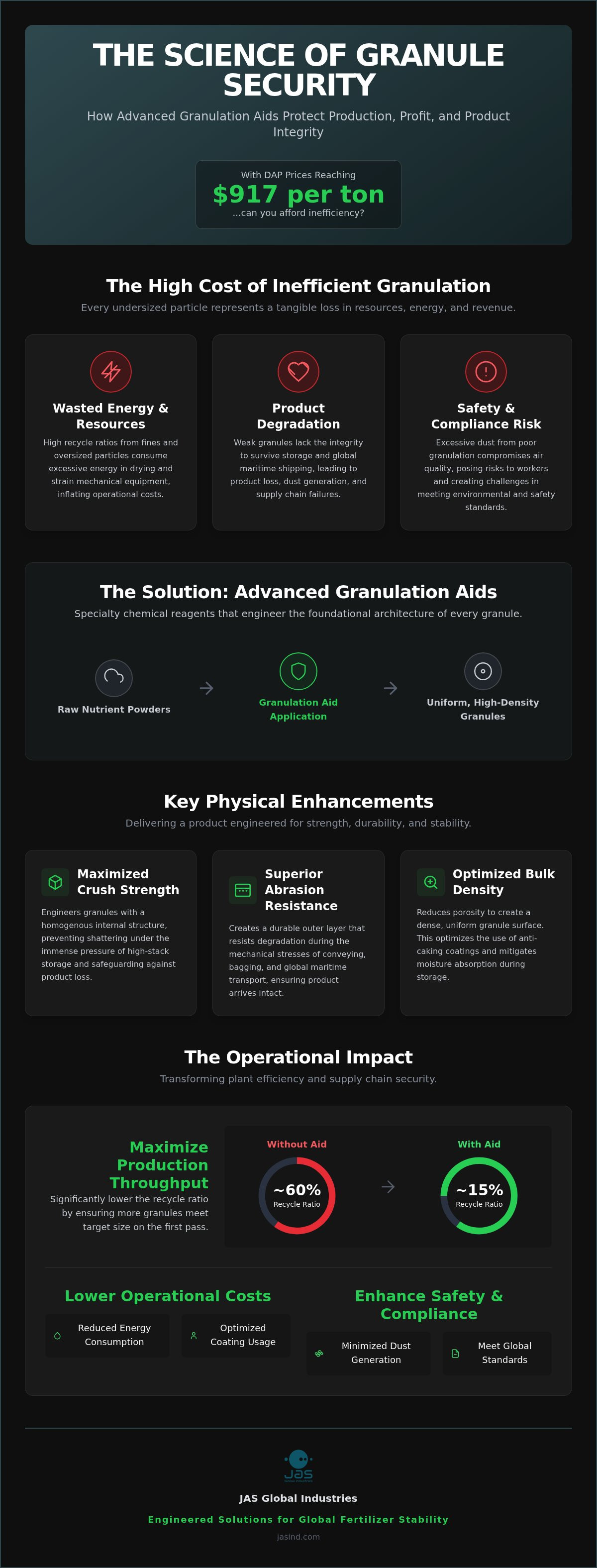
With DAP prices reaching $917 per ton in August 2026, can your facility really afford to lose a significant portion of its production to fines and recycle loops? Every undersized particle represents wasted energy. You know that maintaining granule integrity isn't just a technical requirement; it's a matter of operational security. When you integrate high-performance fertilizer granulation aids into your process, you stop the cycle of inefficiency. High percentages of fines and the constant need for re-processing drain your resources. Inefficient binder usage only compounds these rising costs, putting pressure on your margins.
This article explores how advanced chemical formulations transform these challenges into a competitive advantage. We'll show you how to maximize production yield, reduce dust generation, and ensure full compliance with global environmental standards. By optimizing the physical properties of your product, you ensure that every granule survives the rigors of maritime shipping and bulk handling. Discover a path toward higher throughput and a more stable supply chain through technical precision and resource protection.
Key Takeaways
- Understand the chemical mechanisms that transform raw powders into uniform, high-density granules through effective particle agglomeration.
- Learn how to improve physical characteristics like crush strength and abrasion resistance to protect products during rigorous maritime shipping.
- Discover why tailor-made fertilizer granulation aids outperform generic binders by addressing the specific chemical compatibility of diverse NPK substrates.
- Identify the optimal dosing strategies and mechanical variables required to minimize fines and maximize total production throughput.
- Recognize how specialized chemical formulations provide the foundational security needed to maintain supply chain stability and environmental compliance.
Understanding Fertilizer Granulation Aids: Mechanism and Industrial Significance
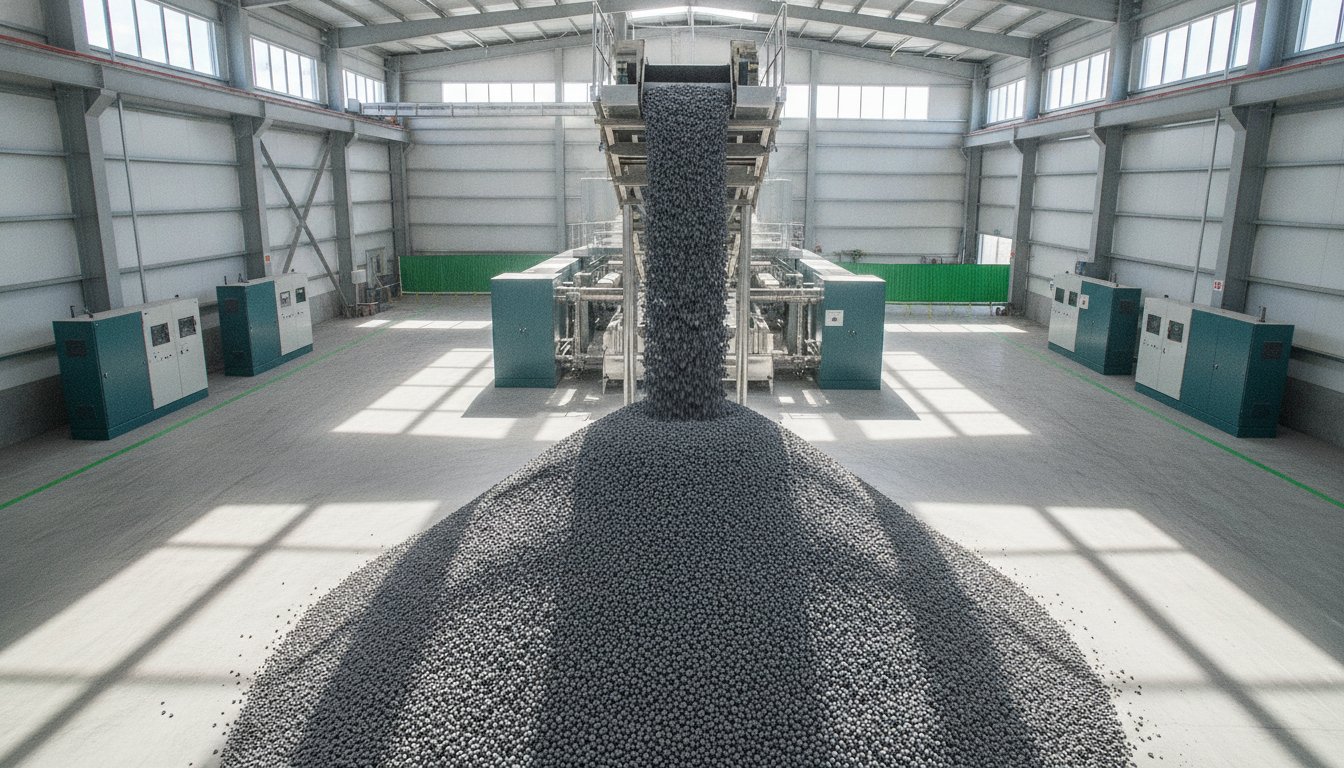
Fertilizer granulation aids are specialty chemical reagents engineered to facilitate the precise agglomeration of particles. They serve as the foundational architecture of the final product. These reagents act as chemical binders, transforming raw, nutrient-dense powders into uniform, high-density granules. In many facilities, the granulation stage represents the primary bottleneck of production efficiency. When this stage fails, plant throughput drops. Operational reliability suffers. By securing the physical structure of the granule, these aids prevent product loss during the rigors of global maritime transport. They ensure that essential nutrients reach their destination without degrading into unusable dust.
The Chemistry of Particle Agglomeration
Successful granulation requires careful management of surface tension. Fertilizer granulation aids modify the properties of the binder to promote liquid bridge formation between solid particles. This interaction is critical within drum or pan granulators. The aid ensures that the liquid binder spreads evenly across the solid substrate. This creates a stronger, more homogenous bond. The capillary effect in fertilizer granulation refers to the pressure differential created by liquid bridges that pulls solid particles together into a cohesive, durable structure. Effective Fertilizer granulation relies on this microscopic physical bond to withstand mechanical stress. Without it, granules lack the internal strength needed for bulk handling. We treat this chemistry as a form of resource protection. It's the difference between a stable product and a failed shipment.
Economic Impact of Granulation Efficiency
Operational efficiency is measured by the recycle ratio. When granulation is inconsistent, a high percentage of "fines" and oversized particles is produced. These materials must return to the start of the circuit. This re-processing isn't just redundant; it's expensive. It consumes excessive energy in the drying stage and strains mechanical equipment. Reducing the recycle ratio is the fastest way to lower energy consumption and increase plant capacity. Specialty additives provide better process control by ensuring more particles fall within the target size range on the first pass.
Minimizing the production of fines also reduces dust generation throughout the facility. This is vital for maintaining a safe working environment and ensuring compliance with global safety standards. Long-term value is found in protecting the physical integrity of these nutrient-rich resources. Consistent granules are easier to store, safer to transport, and more predictable for the end-user. They provide the stability that global agriculture demands. By optimizing the granulation process, manufacturers secure both their profit margins and their reputation for quality.
Technical Parameters: How Granulation Aids Enhance Physical Characteristics
Physical integrity is the bedrock of fertilizer security. High-performance fertilizer granulation aids ensure that every particle functions as a durable vessel for essential nutrients. Beyond simple agglomeration, these specialty additives define the final product's quality through three critical metrics: crush strength, abrasion resistance, and bulk density. When granules possess a homogenous internal structure, they resist the mechanical stresses of the global supply chain. This structural stability is not just a manufacturing goal. It is a safeguard against resource degradation.
Internal morphology directly influences the effectiveness of post-production treatments. High porosity often forces manufacturers to over-apply anti-caking coatings, as the porous surface absorbs the reagent rather than retaining it as a protective film. By creating a denser, more uniform surface, granulation aids optimize the use of subsequent coatings. This synergy reduces overall production costs. It also mitigates the impact of ambient humidity by refining the surface morphology, leaving fewer sites for moisture to anchor and initiate caking.
Maximizing Crush Strength and Durability
Crush strength remains the primary metric for bulk storage reliability. In modern warehouses, fertilizers are often high-stacked to maximize space. If the granules lack sufficient strength, the weight of the stack shatters the particles at the base. This leads to massive product loss and dangerous pile instability. Reducing friability is equally vital. Durable granules must resist shattering during mechanical handling and high-velocity screening. While surface-active agents improve flow, internal binders provide the core structural reinforcement needed for long-term stability. For plants seeking to enhance these metrics, engaging in technical audits for process optimization can reveal the ideal balance of chemical additives.
Controlling Moisture Uptake and Porosity
Managing the Critical Relative Humidity (CRH) of a fertilizer is a global necessity. In high-humidity tropical climates, standard fertilizers often fail due to rapid moisture absorption. Advanced fertilizer granulation aids incorporate pore-blocking technology. This mechanism prevents internal moisture migration, which is the leading cause of granule softening and eventual collapse. By sealing the microscopic pathways within the granule matrix, these aids significantly extend the product's shelf-life. This protection ensures that the fertilizer remains free-flowing and ready for application, regardless of the environmental challenges it faces during transport or storage. Technical precision in the formulation stage provides the security that global agricultural infrastructure requires.
Selecting the Right Formulation for Diverse Fertilizer Substrates
Substrate variability remains a primary challenge for global manufacturers. A binder that performs well with ammonium sulfate often fails entirely when applied to a complex NPK blend. Successful fertilizer granulation aids must account for the specific ionic strengths and surface reactivities of the substrate. While some competitors rely exclusively on organic lignosulfonates, a modern, mission-oriented approach requires a broader toolkit. Synthetic polymers and inorganic salts offer the precision needed for high-value, micronutrient-enriched fertilizers. These custom formulations prevent nutrient segregation; they ensure that every granule delivers a balanced payload. Technical partnerships that utilize global R&I centers allow for the development of these tailor-made solutions, moving beyond off-the-shelf limitations.
Granulation Needs for DAP, MAP, and NPK
Ammonium phosphate production involves intense neutralization stages. The resulting heat of reaction can degrade inferior binders, leading to granule collapse or excessive fines. Manufacturers need reagents that remain stable under thermal stress. In complex NPK formulations, the challenge is managing multiple raw material inputs with varying solubilities. Tailor-made aids optimize the liquid phase during granulation. They ensure uniform particle growth even when the chemical balance of the slurry shifts. This level of process control is essential for maintaining plant throughput and protecting operational margins. Consistency here is the foundation of supply chain security.
Special Considerations for Urea and Potash
Urea granulation presents a unique set of constraints. Its temperature sensitivity and the risk of biuret formation require binders that operate effectively at lower thermal thresholds. Standard chemicals often lack the delicacy needed for these applications. Potash derivatives present a different problem; their crystalline structure often resists traditional agglomeration. High-performance aids improve the compaction and binding of these salts, creating durable granules that withstand long-distance shipping. It's about providing the structural protection these minerals need to remain viable for the end-user.
Sustainability is no longer optional. As regulations like EU 2019/1009 emphasize the circular economy, selecting biodegradable fertilizer granulation aids becomes a strategic necessity. These formulations support organic-certified farming inputs while maintaining the physical security of the product. By matching the chemical reagent to the specific substrate, manufacturers secure the stability of their global resource supply. On-site laboratory testing ensures these formulations meet the specific needs of the local raw materials, providing a reliable path to optimized yield.
Implementation and Process Optimization in the Production Plant
Practical implementation is where chemical potential meets industrial reality. Integrating fertilizer granulation aids into a production circuit requires a precise synchronization of chemical dosing and mechanical variables. Strategic dosing is not a static task. It's a dynamic process that begins with identifying the optimal entry point, typically at the pre-neutralizer or the granulator inlet. By aligning the introduction of reagents with the material flow, manufacturers ensure that the binder is available at the exact moment of particle nucleation. This level of technical precision is what secures high plant throughput and minimizes the energy-intensive recycle loop.
Monitoring real-time performance is essential for maintaining this balance. Granule size distribution (GSD) analysis provides the data needed to make immediate adjustments. When the GSD shifts toward fines, it often indicates a need for increased binder concentration or a change in mechanical settings. Drum speed and tilt angle must complement the chemical properties of the aid. A faster drum speed might require a binder with higher tackiness to maintain agglomeration. Technical audits serve as a vital tool in this environment. They help identify hidden bottlenecks where chemical inefficiencies or mechanical misalignments are draining resources. For facilities looking to refine these variables, you can request a technical audit for process optimization to secure your production yield.
Dosing Strategies and Equipment Integration
Choosing between liquid and powder delivery systems depends largely on your existing plant layout and the specific substrate. Liquid systems are generally preferred for their superior atomization capabilities. The spray pattern is critical. If the binder isn't distributed uniformly across the rolling bed, the result is an inconsistent product with weak internal structures. Automated dosing systems eliminate human error. They ensure that binder application remains consistent across different shifts and varying production loads. This automation is a foundational step toward operational reliability and long-term resource protection.
Troubleshooting Common Granulation Issues
Process disruptions like "mudding" occur when the binder concentration or moisture levels are too high. This leads to oversized, plastic masses that can stall the granulator. Conversely, a "dusty" output suggests that the binder isn't creating sufficient liquid bridges to hold the particles together. These issues are often symptoms of a mismatch between the chemical reagent and the current environmental conditions. Seasonal shifts in ambient humidity significantly impact the granulation balance. To compensate for high humidity, reduce the binder flow rate or concentration by 5 to 10 percent to prevent over-saturation and mudding. Regular calibration of dosing equipment ensures that these adjustments are accurate and effective, protecting the physical integrity of your fertilizer throughout the year.
JAS Global Industries: Engineered Solutions for Global Fertilizer Stability
JAS Global Industries acts as a vital guardian of global resource stability. Since 1998, we've provided the specialty chemical infrastructure that ensures the world's most critical nutrients reach their destination. We don't just supply chemicals; we build long-term technical partnerships. Our "Tailor-Made" philosophy recognizes that every plant is unique. Generic industrial chemicals often fail to address local substrate variations or specific mechanical constraints. By developing customized fertilizer granulation aids, we provide the precise protection needed for consistent, high-yield production. This approach elevates our role from a mere supplier to an indispensable pillar of modern sustainability.
Advanced R&I and Custom Formulations
We leverage multiple global R&I centers to solve complex regional challenges. In the Middle East and Africa, raw material variability often disrupts production flow and compromises granule integrity. Our specialists conduct on-site laboratory testing and comprehensive technical audits to develop specific reagents tailored to these conditions. This focus on operational reliability creates long-term value rather than simple transactional savings. In high-capacity phosphate plants, for instance, our custom formulations have significantly improved yield by reducing the recycle ratio and energy consumption. We prioritize sustainability through process optimization, ensuring that industrial growth aligns with global environmental standards.
Global Reach and Technical Support
Our global service network provides on-site support from Dubai to Europe, ensuring that technical expertise is always within reach. This proximity allows us to respond quickly to evolving plant needs and environmental shifts. A total quality solution often involves integrating high-performance fertilizer granulation aids with specialized anti-caking agents. This holistic approach ensures that granules remain stable from the production drum through long-distance maritime transport to the final application.
Protecting the physical integrity of fertilizers is a foundational step toward global food security and supply chain stability. To initiate a technical audit with JAS Global Industries specialists, facilities can engage our consulting services to identify and eliminate process bottlenecks. We provide the security, expertise, and reliability required for modern industrial infrastructure. Our commitment to cost-effectiveness through engineering ensures that your production yield is maximized while resource waste is minimized. We stand as a steady partner in an increasingly volatile global market.
Securing the Future of Global Nutrient Delivery
Optimizing production yield requires more than just mechanical adjustments. It demands a sophisticated understanding of the chemical interactions at the heart of the granulation drum. By integrating high-performance fertilizer granulation aids, manufacturers transform fragile powders into durable granules capable of withstanding the rigors of global maritime transport. We've explored how tailor-made formulations outperform generic alternatives by addressing specific substrate chemistry and environmental variables. This technical precision is the foundation of operational reliability.
Since 1998, JAS Global Industries has acted as a foundational partner in specialty chemical infrastructure. Our global R&I network and specialized technical consulting for industrial-scale operations provide the security your facility needs to maintain peak throughput. Don't let inefficient binder usage or high recycle ratios compromise your margins. Our mission is to protect your resources through engineered excellence and long-term partnership.
Contact JAS Global Industries for a technical audit of your granulation process to begin optimizing your facility's performance today. Together, we can ensure the stability and security of the global food supply chain.
Frequently Asked Questions
What are the primary benefits of using fertilizer granulation aids?
The primary benefits of using fertilizer granulation aids include increased production throughput, enhanced granule durability, and a significant reduction in the recycle ratio. By optimizing the particle agglomeration process, these specialty chemicals ensure that a higher percentage of material meets size specifications on the first pass. This reliability minimizes waste and protects your operational margins. They also improve the physical integrity of the final product, ensuring it survives the mechanical stresses of global shipping.
How do granulation aids improve the crush strength of fertilizer particles?
Granulation aids improve crush strength by modifying the internal morphology and promoting stronger liquid bridge formation between solid particles. These reagents ensure that the binder distributes uniformly throughout the granule matrix. This creates a denser, more homogenous structure that resists compression. High crush strength is essential for high-stacking in warehouses, where the weight of the pile can easily shatter weaker particles and lead to massive product loss and pile instability.
Can granulation aids be used for both organic and synthetic fertilizers?
Yes, granulation aids can be formulated for both organic and synthetic substrates, provided the chemical reagent matches the specific substrate reactivity. For organic-certified farming, we develop biodegradable formulations that meet strict environmental standards while maintaining structural security. Synthetic fertilizers like Urea or DAP require different chemical approaches to manage temperature sensitivity or ionic strength. Tailor-made solutions ensure that the physical properties remain consistent regardless of the specific nutrient source being processed.
Do granulation aids help in reducing dust during transport?
Granulation aids significantly reduce dust generation by improving abrasion resistance and preventing granule degradation. When particles are structurally sound, they don't break down into fines during the friction of maritime shipping or mechanical conveying. This protection keeps the product free-flowing and safe for handlers. By securing the surface morphology of the granule, these aids ensure that the fertilizer retains its intended form from the production plant to the end-user without losing mass to dust.
What is the difference between a binder and a granulation aid?
A binder is a specific component that provides the adhesive force to hold particles together, while fertilizer granulation aids are comprehensive specialty formulations designed to optimize the entire granulation process. These aids often include surface-active agents, pore-blockers, and chemical stabilizers alongside binding components. They address process bottlenecks like mudding or inconsistent size distribution. While a simple binder might provide strength, a granulation aid provides total process security and operational reliability for the manufacturer.
How do I determine the correct dosing for my specific fertilizer plant?
Determining the correct dosing requires a combination of on-site technical audits and laboratory testing of your specific raw materials. Factors such as ambient humidity, drum speed, and substrate solubility all influence the required concentration. We recommend a dynamic dosing strategy that can be adjusted based on real-time granule size distribution (GSD) analysis. This data-driven approach ensures that you don't over-apply reagents. It helps maintain cost-effectiveness while securing maximum production yield and operational stability.
Are JAS Global Industries granulation aids compatible with NPK blends?
Yes, our granulation aids are specifically engineered for compatibility with complex NPK blends and various nitrogen-phosphorus-potassium ratios. We understand that NPK substrates present unique challenges due to the varying solubilities of their components. Our custom formulations optimize the liquid phase during granulation to ensure uniform particle growth across the entire blend. This technical precision prevents nutrient segregation. It ensures that every granule delivers a balanced and stable nutrient profile to the field, protecting the end-user's crop.
How do granulation aids contribute to industrial energy efficiency?
Granulation aids improve energy efficiency by reducing the recycle ratio, which lowers the thermal load on the drying stage. When more granules fall within the target size range during the first pass, less material needs to be re-processed. Re-processing fines and oversized particles is an energy-intensive cycle that strains mechanical equipment and increases fuel consumption. By stabilizing the granulation circuit, these aids allow the plant to operate at higher capacities with lower per-ton energy consumption.