
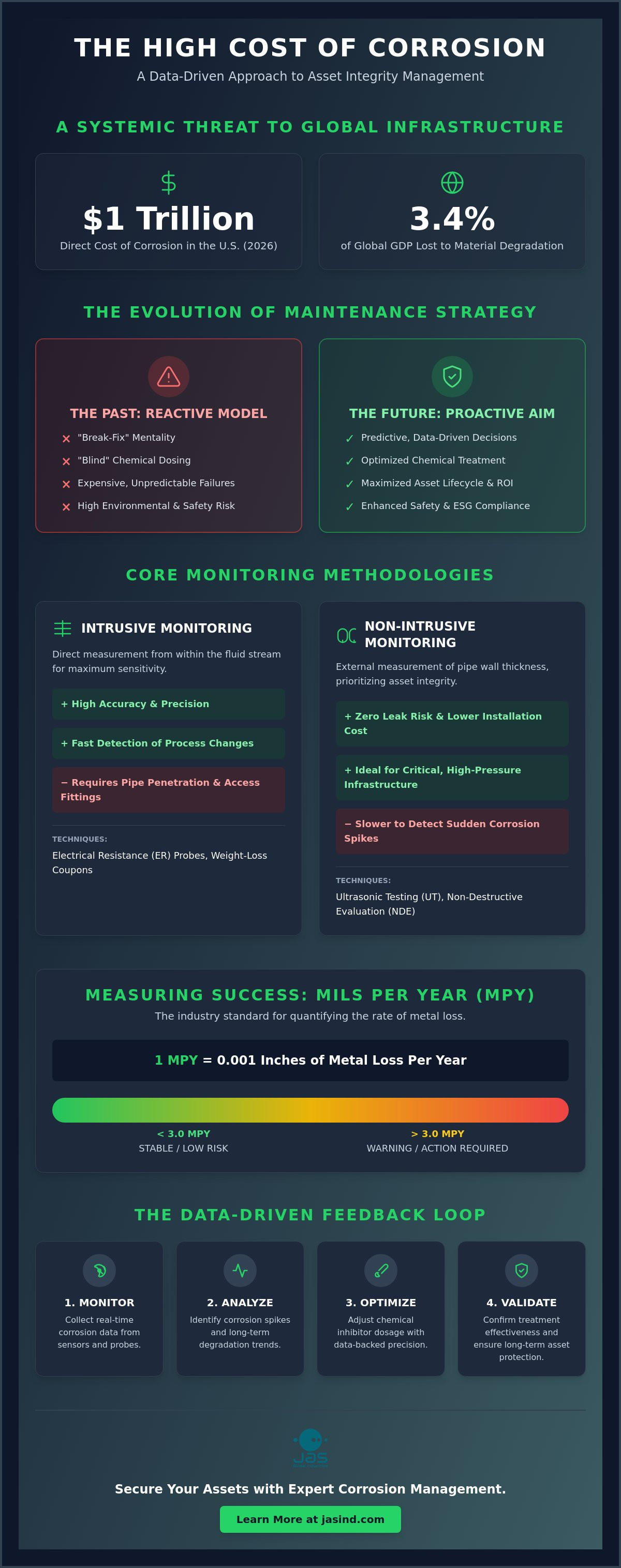
The direct cost of corrosion in the United States has reached $1 trillion as of 2026. This figure represents more than just lost revenue; it reflects a persistent challenge to the integrity of our global infrastructure. For those responsible for facility safety, monitoring corrosion rates in industrial plants is the primary defense against catastrophic failure and environmental risk. Precision is the only path to operational security.
You recognize that "blind" chemical dosing is an expensive gamble that often fails to prevent pipe wall thinning or meet tightening safety standards. We're here to help you move beyond guesswork. This guide provides the strategic frameworks and technical methodologies required to gain real-time visibility into your asset health. We'll examine the shift toward predictive maintenance, the impact of 2027 PHMSA regulatory updates, and the data you need to justify your chemical inhibitor budgets with confidence.
Key Takeaways
- Understand the transition from reactive maintenance to proactive asset integrity management to mitigate the global economic impact of corrosion.
- Evaluate the technical advantages of intrusive and non-intrusive methodologies for monitoring corrosion rates in industrial plants to balance data depth with installation efficiency.
- Establish a precise feedback loop that uses real-time monitoring data to optimize chemical dosing and prevent the localized pitting caused by under-treatment.
- Identify high-risk 'Corrosion Circuits' within your facility to strategically deploy hardware based on fluid phase and environmental variables.
- Discover how integrating advanced water treatment corrosion inhibitors with technical consulting secures long-term infrastructure stability and resource protection.
The Critical Role of Corrosion Monitoring in Modern Industry
Corrosion is not just a localized maintenance headache; it's a systemic threat to global resource stability. While industry benchmarks often cite a 3.4% loss of global GDP due to material degradation, the true cost is measured in the reliability of our essential infrastructure. In sectors like mining and water treatment, asset failure ripples through the entire supply chain. Proactive Asset Integrity Management (AIM) has replaced the old "break-fix" mentality. We don't wait for a leak to occur. Instead, we use data to ensure it never happens.
Effective chemical treatment requires total visibility. Without precise data, you're dosing in the dark. Monitoring corrosion rates in industrial plants provides the essential feedback loop needed to validate chemical efficacy. It's the difference between a calculated strategy and an expensive guess. By utilizing various corrosion monitoring methods, operators can detect subtle changes in electrochemical activity before they escalate into structural compromises. Monitoring serves as the diagnostic eyes of the chemical treatment process, ensuring every drop of inhibitor is used with purpose.
Safety and Environmental Guardianship
Protecting the environment is a core corporate responsibility. In fertilizer and petrochemical processing, even a minor containment breach can lead to soil contamination and heavy regulatory penalties. Modern monitoring helps facilities meet ambitious ESG targets by preventing hazardous leaks and unplanned emissions. A zero-incident safety culture is built upon the foundation of continuous, data-driven asset surveillance. By identifying thinning pipe walls early, we protect both the workforce and the surrounding community from the consequences of mechanical failure.
Maximizing Asset Lifecycle ROI
Infrastructure represents a massive capital investment. Carbon steel pipes and vessels are the lifelines of industrial production, yet they're constantly under attack from corrosive fluids. Extending the useful life of these assets directly impacts the bottom line. Reducing the Total Cost of Ownership (TCO) isn't about buying cheaper chemicals; it's about using the right chemicals at the right time. "Blind" operations carry a risk profile that far outweighs the cost of monitoring technology. When you quantify the rate of degradation, you transform an unpredictable liability into a manageable, predictable variable.
Primary Methodologies for Monitoring Corrosion Rates
Selecting the right methodology is a balance of precision and practicality. While technical guides explain the fundamental principles of corrosion, applying those concepts requires understanding the specific industrial environment. Monitoring corrosion rates in industrial plants involves choosing between direct measurements of metal loss and indirect measurements of corrosive process variables. Direct methods tell you exactly what has happened to the pipe wall. Indirect methods tell you why it's happening by tracking pH, temperature, or dissolved oxygen levels.
Operators must also weigh intrusive vs. non-intrusive techniques. Intrusive probes provide high-accuracy data from the heart of the fluid stream but require specialized access fittings. Non-intrusive methods, like external sensors, offer lower installation costs and zero leak risk. These are often preferred for critical infrastructure where pipe penetration is discouraged. The trade-off is often sensitivity; intrusive probes usually detect changes faster than external sensors can.
Sampling frequency is the heartbeat of a successful monitoring program. In fluctuating process conditions, monthly coupon pulls might miss a sudden, catastrophic oxygen ingress. Real-time probes capture these spikes instantly. Regardless of the tool, the ultimate goal is to convert raw signals into Mils Per Year (MPY). One MPY represents a metal loss of 0.001 inches per year. For mild steel, maintaining rates below 3.0 MPY is a standard benchmark for stability. If your data shows a spike above this threshold, it's a clear signal that your protection strategy needs adjustment.
Physical and Mechanical Techniques
Weight-loss coupons remain the industry's gold standard for baseline data. They're simple. They're reliable. They provide a physical record of the corrosion morphology, such as pitting or uniform thinning. Electrical Resistance (ER) probes offer a more modern alternative. They act like a "wearable" coupon that provides electronic data without requiring a shutdown for retrieval. For external spot checks, ultrasonic testing (UT) and non-destructive evaluation (NDE) allow for non-intrusive wall thickness measurements without penetrating the pressure boundary.
Electrochemical and Advanced Sensors
Linear Polarization Resistance (LPR) provides instantaneous data in aqueous environments. It's the most responsive tool for adjusting chemical dosing on the fly. This level of visibility ensures that water treatment corrosion inhibitors are applied with surgical precision. As we move toward Industry 4.0, IoT-enabled sensors are removing the need for manual data collection. These wireless systems feed directly into asset performance platforms. For more complex scenarios involving protective linings, Electrochemical Impedance Spectroscopy (EIS) offers deep insights into coating degradation and failure prediction.
The Feedback Loop: Monitoring and Chemical Inhibition
In complex industrial ecosystems, monitoring and chemical inhibition must function as a single, unified system. This is the feedback loop. Monitoring corrosion rates in industrial plants provides the raw intelligence required to calibrate chemical intervention. Without this link, an operator is merely reacting to symptoms rather than managing the cause. A robust feedback loop ensures that chemical dosage remains in perfect sync with the corrosive potential of the process fluid. It transforms a static treatment plan into a dynamic defense strategy.
Precision in dosing is a matter of both ethics and economics. Under-dosing is a high-risk strategy that invites localized pitting; these deep, narrow penetrations can cause rapid pipe failure even when the overall metal loss remains low. Conversely, over-dosing represents a significant waste of capital. It places an unnecessary environmental load on discharge systems. By implementing a corrosion monitoring strategy that feeds directly into automated chemical injection skids, facilities can achieve a state of dynamic equilibrium. This integration protects the asset while minimizing the chemical footprint.
Optimizing Water Treatment Corrosion Inhibitors
Maintaining water security requires constant vigilance over infrastructure health. In thermal desalination and reverse osmosis plants, high chloride concentrations create a relentless corrosive environment. Monitoring performance data allows for the precise application of inhibitors. This dual-action approach is a core component of industrial water treatment strategies. When scale and corrosion monitoring work in tandem, they secure the long-term viability of the world's most critical water supplies.
Managing Corrosive Flux in Mining and Fertilizers
Mining environments present unique challenges due to high-solids slurries and abrasive flotation circuits. Monitoring corrosion rates in industrial plants within the mining sector ensures that chemical protection keeps pace with physical wear. Specialized mining solutions rely on this data to optimize mineral recovery while safeguarding processing equipment. In fertilizer production, where hydrogen sulfide is often present, monitoring becomes even more vital. Effective h2s treatment requires real-time data to neutralize the gas before it compromises structural integrity or worker safety.
Implementing a Robust Corrosion Monitoring Strategy
A successful strategy is a multi-phased commitment to asset longevity. It begins with a granular understanding of the facility's architecture. Monitoring corrosion rates in industrial plants isn't a "plug-and-play" solution; it's a rigorous engineering discipline that requires continuous refinement. To move from reactive maintenance to proactive protection, facilities must follow a structured implementation path.
- Step 1: Identify 'Corrosion Circuits.' Group equipment with similar metallurgical and process conditions. Prioritize high-risk injection points where chemical inhibitors enter the stream.
- Step 2: Select hardware based on fluid phase. Gas phases require different probe sensitivities than aqueous slurries or hydrocarbon streams. Match the metallurgy of the sensor to the pipe wall for accurate representation.
- Step 3: Establish a baseline. You can't measure the success of an inhibitor if you don't know the unmitigated corrosion rate. Record these initial values before introducing chemical intervention.
- Step 4: Set alarm thresholds. Data is only valuable if it triggers a response. Define specific MPY levels that require immediate investigation or automated dosing adjustments.
- Step 5: Audit and recalibrate. Probes foul and process conditions drift. Annual system reviews ensure the data remains actionable and accurate.
Developing a Chemicals Management Plan
A monitoring program must be codified within a broader chemicals management plan. This document defines the critical interplay between process engineers and chemical suppliers. It ensures that monitoring data isn't siloed but instead drives procurement and dosing decisions. With the PHMSA incorporating updated AMPP standards into federal law by January 1, 2027, maintaining a clear audit trail is no longer optional. It's a regulatory necessity for ensuring global infrastructure security.
Overcoming Common Implementation Challenges
High-velocity flows often generate "noisy" data that can mask actual corrosion trends. Filtering this signal requires sophisticated software and proper probe orientation. Additionally, aggressive process chemicals can sometimes degrade the monitoring hardware itself. Ensure your probes are metallurgically compatible with the specific chemistry of your circuit. Sensors should always be installed in sections of laminar flow to avoid the signal interference caused by turbulent eddies near bends or valves.
For a customized assessment of your facility's protection needs, explore our full range of industrial chemical solutions.
Strategic Chemical Solutions for Corrosion Mitigation
Asset integrity management reaches its logical conclusion with the application of high-performance chemistry. While monitoring corrosion rates in industrial plants provides the diagnostic intelligence required for intervention, the ultimate resolution lies in strategic mitigation. JAS Global Industries approaches this challenge through a lens of total resource security. We don't provide generic, off-the-shelf reagents. Instead, we engineer specific molecules to address the unique metallurgical and environmental conditions of each facility. This precision ensures that infrastructure remains a stable pillar of global production.
Our Research and Innovation (R&I) centers act as the engines of this progress. By simulating extreme industrial environments, our scientists develop the next generation of inhibitors and protective agents. These efforts are guided by a commitment to global sustainability. We prioritize low-toxicity, biodegradable formulations that meet the highest ESG standards without compromising on protective performance. Reliability is further secured through our integrated global supply chain, which ensures that critical industrial reagents reach their destination regardless of geographical complexity.
Tailor-Made Formulations for Global Industry
Mining operations often encounter unique challenges based on the specific mineralogy of the ore body. A standard inhibitor might fail when faced with high-solids slurries or complex mineral flux. We develop bespoke solutions that integrate advanced surfactant chemistry to provide enhanced metal protection in these aggressive environments. This level of customization extends to the fertilizer and petrochemical sectors, where the chemical composition of the process fluid dictates the molecular structure of the required treatment. By focusing on the micro-level interactions between the chemical and the metal surface, we provide a macro-level impact on asset lifespan.
Partnering for Long-Term Reliability
True asset protection requires a move away from simple bulk supply toward performance-based partnerships. We view our clients as long-term collaborators in the mission of infrastructure security. This partnership includes on-site laboratory testing, technical audits, and continuous process optimization. Monitoring corrosion rates in industrial plants becomes a shared responsibility where data-driven insights lead to immediate, actionable improvements in plant efficiency. Our technical consultants work alongside your engineers to ensure that every dosing decision is justified by real-time health metrics. This holistic approach transforms chemical treatment from an operational expense into a strategic investment in stability.
Don't leave your infrastructure to chance. Consult with JAS Global Industries to optimize your plant's corrosion monitoring and chemical strategy for long-term security.
Securing the Future of Industrial Infrastructure
Asset integrity is a continuous commitment to operational stability. By mastering the technical frameworks for monitoring corrosion rates in industrial plants, you move beyond guesswork into a realm of data-driven security. This strategic transition protects your capital investments, ensures regulatory compliance, and prevents the catastrophic failures that threaten both personnel and the environment. Precision monitoring is the essential prerequisite for any modern resource protection strategy.
JAS Global Industries has served as a vital pillar of industrial infrastructure since 1998. With an established presence spanning the Middle East, Africa, Asia, and Europe, we provide the global reliability required for critical resource management. Our dedicated Research and Innovation centers focus on translating monitoring data into precise chemical solutions, ensuring that every facility we support achieves its maximum productive lifespan. We remain dedicated to the stability of the world's most essential industries through long-term technical partnerships.
Partner with JAS Global Industries for Advanced Process Optimization and transform your data into a shield for your assets. Every drop of chemistry should be a calculated step toward long-term operational security.
Frequently Asked Questions
What is the standard unit of measurement for corrosion rates in industrial plants?
The standard unit for quantifying material loss is Mils Per Year (MPY). One MPY represents a metal loss of 0.001 inches per year from the asset's surface. This metric allows engineers to calculate the remaining useful life of critical infrastructure. For mild steel in industrial water systems, maintaining a rate below 3.0 MPY is a common benchmark for stability.
How often should corrosion coupons be replaced and analysed?
Corrosion coupons are typically replaced and analysed every 30 to 90 days. Short-term exposures of 30 days are effective for identifying rapid changes in process chemistry or inhibitor performance. Longer exposures of 90 days provide a more reliable baseline for uniform corrosion trends. If your process conditions fluctuate frequently, more regular intervals may be necessary to ensure data accuracy.
Can corrosion monitoring systems be integrated with existing SCADA or DCS platforms?
Modern digital monitoring systems integrate seamlessly with existing SCADA or DCS platforms. Probes utilize standard communication protocols like 4-20mA, Modbus, or HART to transmit real-time data directly to the control room. This connectivity allows operators to automate chemical dosing based on live trends. It transforms monitoring from a manual collection task into an integrated part of the plant's automation architecture.
What is the difference between intrusive and non-intrusive monitoring?
Intrusive monitoring involves placing sensors directly into the process fluid through specialized access fittings. This provides high-accuracy data from the heart of the corrosive environment. Non-intrusive techniques, such as ultrasonic sensors or field signature mapping, are mounted on the pipe's exterior. While non-intrusive methods eliminate the risk of containment breaches, they often lack the immediate sensitivity of intrusive probes.
How do I choose between LPR and ER probes for my facility?
Choose Linear Polarization Resistance (LPR) probes if you're monitoring corrosion rates in industrial plants with aqueous, conductive liquids. LPR provides nearly instantaneous data, making it ideal for optimizing water treatment inhibitors. Electrical Resistance (ER) probes are more versatile. They work in any environment, including gases and non-conductive oils, but they take longer to detect subtle changes in wall thickness.
Is it possible to monitor corrosion in high-temperature or high-pressure environments?
Monitoring is entirely possible in high-temperature and high-pressure environments using specialized hardware. High-pressure access fittings allow for the safe insertion and retrieval of probes while the system is online. Materials for these sensors are often upgraded to exotic alloys to withstand extreme thermal and mechanical stress. Ensuring your monitoring equipment matches the design pressure of your piping is essential for maintaining safety.
Does monitoring help in reducing the environmental impact of a plant?
Robust monitoring significantly reduces a plant's environmental footprint by preventing containment breaches and hazardous leaks. It also eliminates the waste associated with over-dosing chemical inhibitors. By applying only the necessary amount of reagent to protect the asset, facilities reduce the chemical load on their discharge systems. This alignment with ESG goals ensures that industrial growth doesn't compromise ecological health.
What are the first signs that a corrosion monitoring strategy needs revision?
The first sign that your strategy needs revision is a mismatch between monitoring data and physical inspections. If your probes report low corrosion but you discover unexpected pitting during a turnaround, your sensor placement is likely flawed. Other indicators include skyrocketing chemical costs with no measurable improvement in asset health. Frequent alarms or "noisy" data signals also suggest that your hardware or alarm thresholds require recalibration.