

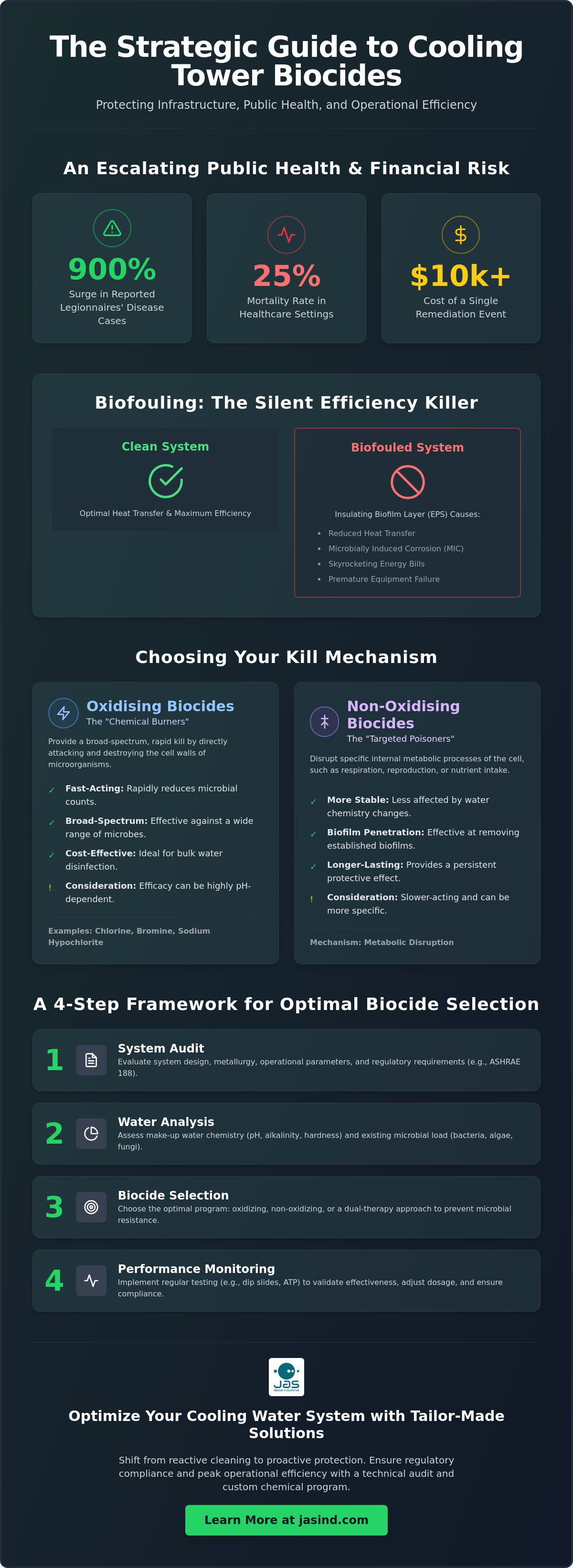
Reported cases of Legionnaires' disease surged by approximately 900% in recent decades, carrying a mortality rate as high as 25% in healthcare settings. This statistic isn't just a warning; it's a call for industrial leaders to prioritize the security of their water systems. Biofouling isn't merely a maintenance headache that reduces heat transfer efficiency. It's a fundamental risk to public safety and corporate stability. You likely recognize that chemical overdosing leads to rising costs, yet the alternative of a $10,000 remediation event or a regulatory breach is far worse.
We understand that maintaining operational continuity while meeting strict environmental standards is a complex balancing act. This guide provides a clear rationale for how to select a biocide for cooling towers to ensure your infrastructure remains resilient and compliant with global standards like ASHRAE 188. You'll master the technical criteria needed to stabilize your system and protect your community. We will examine the critical differences between oxidizing and non-oxidizing agents, the impact of New York City’s 2026 monthly sampling mandates, and strategies to reduce system downtime through precise chemical selection.
Key Takeaways
- Distinguish between oxidizing and non-oxidizing agents to deploy the correct kill mechanism for your specific industrial environment.
- Apply a technical four-step framework on how to select a biocide for cooling towers that balances water alkalinity with system metallurgy.
- Identify strategies to penetrate the Extracellular Polymeric Substance (EPS) layer, ensuring deep disinfection of persistent biofilms.
- Evaluate the benefits of dual-therapy programs to prevent microbial resistance and preserve the longevity of critical infrastructure.
- Shift toward tailor-made chemical solutions and technical audits to ensure regulatory compliance and peak operational efficiency.
The Strategic Role of Biocides in Cooling Tower Stability
Cooling towers are the heartbeat of modern industrial infrastructure. They facilitate everything from power generation to large scale manufacturing. Without rigorous microbial control, these systems face rapid degradation. Biocides serve as the primary defense against biofouling. They prevent the accumulation of organic matter that compromises heat transfer. Understanding how to select a biocide for cooling towers is not a mere procurement task; it is a strategic decision that ensures long term operational stability. This process requires a shift in perspective. We must view water treatment as a vital guardian of global resources.
Effective industrial water treatment has evolved beyond simple maintenance. We no longer wait for a system to fail before acting. The focus is now on proactive protection. This approach treats water as a critical asset rather than a waste stream. By integrating high performance biocides, facilities move from expensive reactive cleaning to a state of constant readiness. This transition is essential for maintaining the security of critical infrastructure and ensuring the longevity of expensive capital equipment.
Biofouling: The Silent Efficiency Killer
Biofilm is a deceptive adversary. It creates a thin, insulating layer on heat exchangers that drastically reduces thermal efficiency. Even a microscopic film can cause a significant energy penalty. This organic layer also harbors anaerobic bacteria. These organisms trigger microbially induced corrosion (MIC), which eats through system metallurgy. Poor microbial control leads to premature equipment failure and skyrocketing energy bills. Maintaining Cooling Tower Fundamentals requires a deep understanding of these biological threats. When you master how to select a biocide for cooling towers, you effectively neutralize these silent killers before they impact your bottom line.
Legionella Control and Regulatory Responsibility
The human cost of mismanagement is profound. With Legionnaires' disease cases increasing by 900% since 2000, the stakes have never been higher. Regulatory bodies now demand strict adherence to standards like ASHRAE 188. Failure to comply leads to legal liability and, more importantly, puts local communities at risk. Strategic biocide selection ensures that your facility meets international health and safety protocols. It transforms your water management program into a pillar of public safety. Rigorous chemical dosing protects your personnel and demonstrates a commitment to global safety standards. This proactive stance is the hallmark of a responsible corporate citizen.
Oxidising vs. Non-Oxidising Biocides: Kill Mechanisms
The effectiveness of a water treatment program depends on the precision of its chemical arsenal. To protect critical infrastructure, we must look beyond simple disinfection and understand the specific biological kill mechanisms at play. When determining how to select a biocide for cooling towers, the primary decision involves choosing between oxidising and non-oxidising chemistries. Each serves a distinct role in maintaining system security and operational uptime.
Oxidising biocides function as chemical "burners." They provide a broad spectrum, rapid kill by directly attacking and destroying the cell walls of microorganisms. In contrast, non-oxidising biocides act as targeted "poisoners." They disrupt the internal metabolic processes of the cell, such as respiration or reproduction. For facilities managing complex water chemistries, exploring specialized water treatment biocides can provide the necessary stability for critical operations. The choice isn't always exclusive; many robust programs utilize both to ensure no microbial resistance develops.
The Oxidising Approach: Fast and Broad-Spectrum
Oxidisers are the workhorses of bulk water disinfection. They are highly effective at low concentrations and offer rapid-kill kinetics that keep microbial counts in check. Common agents include:
- Chlorine: A cost effective standard, though its efficacy drops significantly as pH levels rise above 7.5.
- Bromine: Superior to chlorine in high pH environments, making it a preferred choice for many modern cooling systems.
- Sodium Hypochlorite: A liquid alternative that simplifies handling while maintaining strong oxidising power.
While these agents are powerful, they aren't without risk. Excessive use can increase the corrosivity of the water, potentially damaging copper or mild steel components. They are also easily consumed by organic debris, which means high organic loads will skyrocket your chemical consumption rates.
The Non-Oxidising Approach: Persistent and Targeted
Non-oxidising biocides offer a level of stability that oxidisers cannot match. They don't react with organic matter or system metallurgy in the same aggressive way. This makes them ideal for systems with high "demand" or those prone to heavy biofilm accumulation. Key chemistries include:
- DBNPA: Known for its extremely fast kill and rapid degradation into harmless byproducts.
- Glutaraldehyde: A versatile and powerful agent that penetrates thick biofilms effectively.
- Isothiazolinone: Provides long term residual control at low dosages.
Understanding how to select a biocide for cooling towers requires balancing these mechanisms against your specific system stressors. If your tower operates in a dusty environment or processes water with high organic content, the persistence of a non-oxidiser is often the only way to maintain control. By selecting the right chemistry, you ensure the protection of both your equipment and the people who rely on its stability.
A 4-Step Framework for Selecting the Right Biocide
Developing a robust microbial control strategy requires a systematic approach. You can't rely on guesswork when the integrity of your infrastructure is at stake. To understand how to select a biocide for cooling towers, you must evaluate the unique environmental and mechanical stressors of your facility. This framework ensures that your chemical program is both effective and sustainable. It moves your operation from simple maintenance to a state of total system security.
- Step 1: Analyse Water Chemistry. Your water's pH, alkalinity, and total dissolved solids (TDS) are the primary gatekeepers of biocide efficacy. High alkalinity can buffer pH levels, potentially neutralizing certain chemical agents before they reach the target organisms.
- Step 2: Evaluate System Metallurgy. Every cooling tower is a mix of materials. Whether you're managing copper heat exchangers or stainless steel basins, your biocide must be compatible with these surfaces to prevent accelerated degradation.
- Step 3: Determine Retention Time. You must match the biocide's half-life to your system’s blowdown rate. If a chemical degrades too quickly in a system with low turnover, you lose protection; if it persists too long in a high-blowdown system, you risk environmental discharge violations.
- Step 4: Regulatory and Environmental Audit. Compliance isn't optional. You must ensure that your chosen chemistry meets local discharge limits and safety protocols. This includes staying ahead of monthly sampling requirements now common in many jurisdictions.
The pH Factor: Why Chemistry Dictates Efficacy
Many operators overlook the profound impact of pH on microbial control. Traditional chlorine loses over 50% of its efficacy once pH climbs above 7.5. In these alkaline environments, bromine or stabilized oxidisers become the superior choice for maintaining system security. The pKa of a biocide is the specific pH value at which the chemical is 50% dissociated, serving as a critical indicator of its ability to penetrate microbial cell walls and maintain high kill-rates. Selecting an agent with a pKa that aligns with your operating pH ensures that your treatment remains active and potent.
Metallurgy and Corrosion Protection
Protecting your physical assets is as vital as controlling bacteria. Aggressive oxidisers can strip protective films from copper alloys, leading to localized pitting. There is a critical synergy between biocides and Water Treatment Corrosion Inhibitors. When you master how to select a biocide for cooling towers, you choose chemistries that complement your inhibitor program rather than fighting against it. This holistic view prevents premature equipment failure. It ensures that your cooling tower remains a reliable pillar of your industrial process, protecting both your investment and your operational uptime.
Strategies for Biofilm Removal and Microbial Resistance
Microorganisms are survivors. They don't simply drift in the bulk water; they colonize surfaces by secreting an Extracellular Polymeric Substance (EPS). This organic matrix acts as a biological fortress. It shields bacteria from chemical attacks and environmental stressors. When you evaluate how to select a biocide for cooling towers, you must account for this protective layer. Relying on a single chemical agent, or mono-therapy, often leads to failure over long term operations. Microbes adapt to constant chemical pressure, developing resistance that renders standard dosages ineffective.
To maintain system security, industrial leaders must move toward sophisticated dual-biocide programs. This involves either synergistic dosing, where two chemicals work together to enhance kill-rates, or alternating strategies that prevent microbial immunity. These methods ensure that your cooling tower remains a stable component of your industrial process. By disrupting the life cycle of biofilms, you protect your heat exchangers from the insulating effects of organic growth and the threat of microbially induced corrosion. To implement these advanced strategies, consider our specialized Water Treatment Biocides and Dispersant Agents designed for complex industrial environments.
Alternating Biocide Programs to Prevent Immunity
Adaptation is the greatest threat to microbial control. If you use the same oxidiser daily, the surviving population becomes increasingly resilient. We recommend switching between an oxidising agent and a non-oxidising agent on a set schedule. This "shock" to the system disrupts the metabolic pathways of the bacteria before they can adjust. The optimal frequency for these rotations depends on your system's specific microbial load and water turnover rate. Regular monitoring is essential. Use ATP testing or dip slides to verify that your rotation strategy is maintaining the low microbial counts required for operational stability.
The Power of Biodispersants
Biocides alone often cannot penetrate a mature biofilm. This is where biodispersants become vital. These agents act as a "can opener" for the EPS layer. They loosen and detach the organic slime from metal surfaces, exposing the underlying bacteria to the biocide. This synergy allows for a more effective kill and often reduces the total biocide dosage required. Beyond disinfection, biodispersants play a direct role in energy efficiency. By stripping organic layers from heat transfer surfaces, they restore optimal thermal conductivity. This proactive approach ensures your system operates at peak performance while extending the life of your critical infrastructure.
Optimising Cooling Water Systems with JAS Global Industries
Technical knowledge is the foundation of system stability. However, translating the theory of how to select a biocide for cooling towers into a high-performing field application requires a partner with a global perspective. JAS Global Industries provides more than just chemical supplies. We offer a comprehensive shield for your industrial assets. Our approach moves beyond off-the-shelf commodity chemicals. We focus on tailor-made formulations that address the specific biological and metallurgical stressors of your unique environment.
Reliability is built on presence. With a logistics network spanning the Middle East, Africa, Asia, and Europe, we ensure that critical water treatment solutions are always within reach. We view ourselves as a vital guardian of industrial resources. This mission drives us to deliver sustainable technologies that balance environmental stewardship with cost-effective performance. Our commitment to global resource security ensures that your facility remains a stable pillar of modern infrastructure.
Custom Dosing Strategies for Operational Reliability
Every industrial site has a unique fingerprint. A generic dosing schedule often leads to chemical waste or, worse, system failure. We develop site-specific chemical management plans that prioritize precision. By leveraging our dedicated R&I centres, we solve complex microbial challenges that others overlook. These facilities allow us to simulate field conditions and refine chemistries before they ever reach your tower. Our goal is long-term partnership value. We focus on process optimization that reduces the total cost of ownership while maximizing uptime.
A Global Partner for Water Security
Stability is the ultimate industrial currency. Our Water Treatment Biocides are essential contributors to the protection of global water resources. By preventing outbreaks and ensuring heat transfer efficiency, we support the fundamental needs of society. We invite you to move from a transactional relationship to a strategic alliance focused on protection. Contact our technical team today for a comprehensive water system audit. Let's work together to master how to select a biocide for cooling towers and secure the future of your operations.
Securing the Future of Industrial Water Infrastructure
Effective microbial control is a pillar of global resource security. By applying a technical four-step framework and implementing dual-biocide rotations, you move beyond reactive maintenance into proactive protection. This strategic approach ensures that your cooling towers remain efficient, compliant, and resilient against persistent biofilms. Understanding how to select a biocide for cooling towers is more than a technical requirement; it's a commitment to operational longevity and community safety.
Operational since 1998, JAS Global Industries serves as a reliable guardian for critical infrastructure. We leverage multiple global R&I centers to develop specialized, tailor-made industrial formulations that solve your most complex water chemistry challenges. Our mission is to provide the stability and security your facility demands. Partner with JAS Global Industries for Advanced Water Treatment Solutions and ensure your systems operate at peak performance for years to come. We look forward to building a long-term partnership rooted in technical excellence and shared responsibility.
Frequently Asked Questions
What is the difference between oxidizing and non-oxidizing biocides?
Oxidizing biocides kill microorganisms by destroying their cell walls through direct chemical oxidation. Common examples include chlorine and bromine, which are effective for bulk water disinfection. Non-oxidizing biocides act as targeted toxins that disrupt the internal metabolism, respiration, or reproduction of the cell. These agents, such as DBNPA or Glutaraldehyde, are often more stable in systems with high organic loads where oxidizers would be quickly consumed.
How often should I change or alternate my cooling tower biocide?
Most industrial programs alternate chemistries on a weekly or bi-weekly schedule to prevent microbial adaptation. The exact frequency depends on your system's specific turnover rate and the results of regular microbial monitoring. If you notice a spike in ATP test results or dip slide counts, it's often a signal that your current rotation needs adjustment to disrupt emerging resistance patterns within the tower.
Can pH levels affect the performance of my biocide program?
Yes, pH is a primary factor in chemical efficacy. Traditional chlorine loses more than 50% of its disinfecting power when pH levels rise above 7.5. Understanding how to select a biocide for cooling towers involves matching the chemical's pKa to your system's operating pH. For alkaline systems, bromine or stabilized oxidizers are superior choices because they maintain their active form in high-pH environments, ensuring consistent protection of your infrastructure.
Is it safe to use chlorine in a cooling tower with copper heat exchangers?
Chlorine is safe only when you maintain strictly controlled residual levels and utilize high-quality corrosion inhibitors. Excessive free chlorine can strip the protective oxide film from copper surfaces, leading to localized pitting and premature equipment failure. Precise dosing is essential. You must balance the need for aggressive disinfection with the requirement to protect sensitive metallurgy from chemical degradation.
How do I know if my cooling tower biocide is actually working?
Efficacy is verified through quantitative testing methods like ATP bioluminescence, dip slides, or heterotrophic plate counts. You should observe a measurable drop in microbial activity shortly after a dose is applied. If counts remain elevated despite treatment, it typically indicates that the bacteria have developed resistance or are shielded by a thick biofilm layer that the biocide cannot penetrate on its own.
What are the environmental regulations regarding biocide discharge?
Regulations are increasingly strict and vary significantly by region. For example, New York City Local Law 159 increased the required frequency of Legionella sampling to monthly as of May 2026. Most jurisdictions also set limits on the concentration of residual chemicals allowed in blowdown water. You must ensure your discharge meets local aquatic toxicity standards to avoid legal liability and environmental fines.
Can I use a single biocide to control Legionella effectively?
A single biocide is rarely sufficient for comprehensive Legionella risk management. Bacteria often survive within the protective matrix of a biofilm where a single agent cannot reach them. Mastering how to select a biocide for cooling towers typically involves implementing a dual-therapy program. Combining an oxidizing biocide for bulk water with a non-oxidizing agent for biofilm penetration provides the most reliable defense against Legionellosis outbreaks.
What role do biodispersants play in a cooling tower water treatment plan?
Biodispersants function as wetting agents that loosen and detach organic slime from system surfaces. While they don't kill bacteria directly, they expose them to the biocide by stripping away their protective organic layers. This synergy improves heat transfer efficiency and allows your biocide program to work more effectively at lower dosages. It's a critical component for maintaining the long-term stability of any industrial cooling system.