
What if the greatest threat to your mine's profitability isn't the declining ore grade, but the fluid dynamics of the slurry itself? As operations process finer materials to meet global demand, high-viscosity ores are creating massive operational bottlenecks. You're likely seeing energy costs climb as pumps struggle to move thick materials, while water scarcity makes simple dilution an impossible luxury. Learning how to reduce slurry viscosity in mining is no longer just a technical preference. It's a requirement for survival in a 2026 market where the global slurry system market is rapidly expanding toward a 16.1 billion dollar valuation.
We believe that managing rheology is a vital contribution to global resource stability. This guide reveals the chemical and mechanical strategies to optimize your slurry, increase plant throughput, and ensure long-term operational security. We'll examine the impact of new 2026 environmental standards, such as Canada's Coal Mining Effluent Regulations, and the specific role of dispersant agents in maintaining flow. You'll gain the insights needed to increase solids concentration, improve metal recovery, and significantly reduce wear on your pumps and pipelines.
Key Takeaways
- Learn how to reduce slurry viscosity in mining by balancing chemical additives with mechanical adjustments to overcome operational bottlenecks.
- Understand how dispersant agents and grinding aids prevent particle re-agglomeration to maintain fluid stability and plant safety.
- Discover methods for optimizing particle size distribution to improve packing density without relying on scarce water resources.
- Explore specialized rheology strategies for gold and phosphate mining that protect yields and enhance mineral recovery rates.
- Identify why custom-engineered chemical solutions are essential for long-term resource security and sustainable infrastructure development.
The Impact of Slurry Rheology on Mineral Processing Efficiency
Slurry rheology is the heartbeat of a mineral processing plant. When flow is optimized, the entire operation remains stable. When viscosity rises, the system begins to fail. Understanding The Impact of Slurry Rheology is the first step in securing our global resource supply chain. Efficient mineral extraction depends on the ability to move solids through liquid media with minimal resistance. This isn't merely a fluid mechanics challenge. It's a strategic lever for industrial stability and environmental responsibility.
Viscosity vs. Yield Stress: Why Both Matter
The Consequences of Poor Flowability
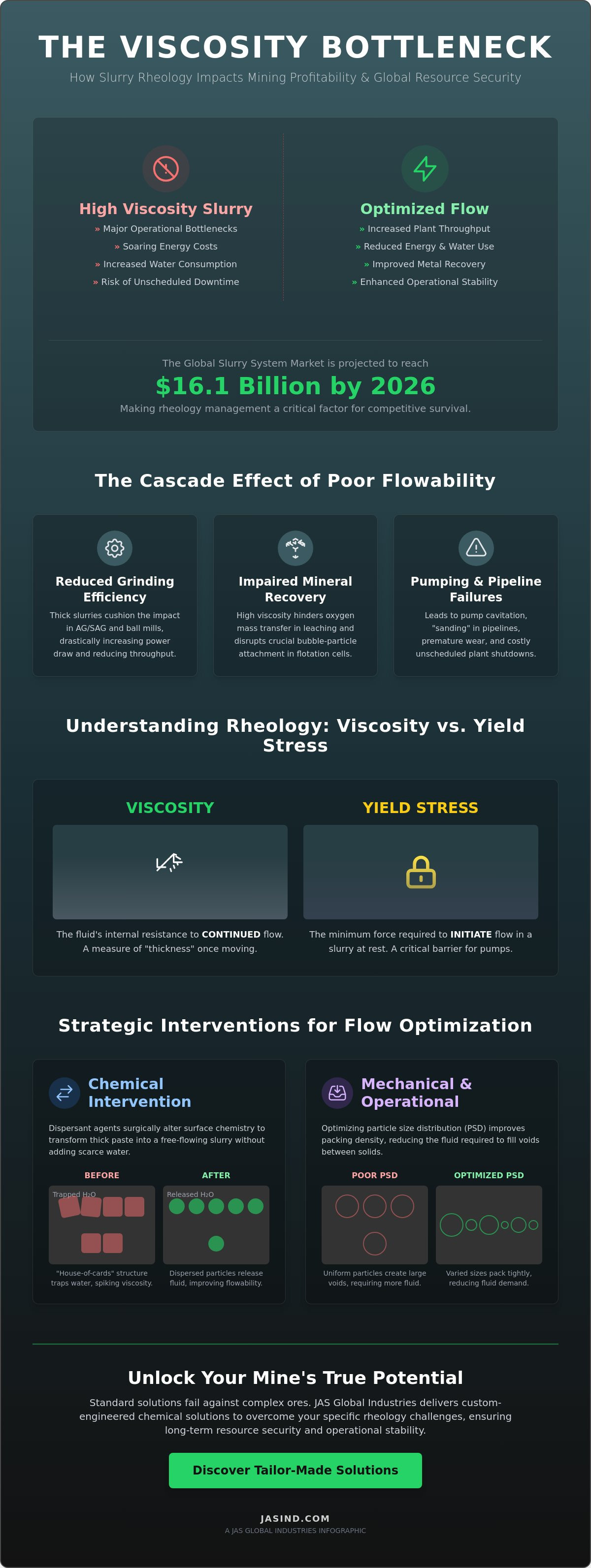
High viscosity acts as a brake on every stage of production. It creates a cascade of inefficiencies that can stop a plant in its tracks. Common bottlenecks include:
- Reduced Grinding Efficiency: Thick slurries cushion the impact between grinding media and ore in AG/SAG and ball mills, increasing power draw.
- Impaired Mineral Recovery: High-viscosity environments hinder oxygen mass transfer in leaching and disrupt bubble buoyancy in flotation cells.
- Pumping Failures: High-yield stress leads to pump cavitation and "sanding" in pipelines, causing costly unscheduled downtime.
Managing viscosity is a pillar of global resource security. As ore grades decline, mines must process more material to reach the same output. This creates a cycle of high water consumption and excessive energy use. Effective rheology management breaks this cycle. It allows for the processing of complex, high-viscosity ores while protecting the environmental and economic integrity of the operation. We view this as a mission. We provide the stability required for modern society to thrive.
Chemical Mechanisms for Reducing Slurry Viscosity
Chemical intervention offers a surgical approach to rheology management. Unlike water dilution, which often depletes local resources, chemical additives target the physical interactions between particles at the molecular level. This is the most effective strategy for how to reduce slurry viscosity in mining without compromising the water balance of the site. By neutralizing the attractive forces between mineral solids, these agents transform a thick, stagnant paste into a free-flowing slurry. This transition is essential for maintaining the stability of global resource extraction.
Dispersant Agents and Surface Chemistry
Dispersant agents work by altering the zeta potential of mineral surfaces. In clay-heavy ores, particles often form a "house-of-cards" structure that traps water and spikes viscosity. Surfactants disrupt this arrangement, releasing the trapped fluid and improving flowability. Research on Chemical Mechanisms for Reducing Slurry Viscosity highlights how electrosteric stabilization provides a dual layer of protection. This mechanism uses both electrical charge repulsion and physical polymer barriers to keep particles separated. It's essential to select dispersants that don't interfere with mining flotation collectors, as chemical compatibility is the foundation of downstream recovery.
Mining Grinding Aids as Rheology Modifiers
The milling circuit is where rheology directly impacts the bottom line. Fine particles have a tendency to coat grinding media, creating a "cushioning" effect that wastes energy and slows production. Mining grinding aids act as specialized rheology modifiers that prevent this re-agglomeration. By maintaining a lower viscosity within the mill, these chemicals allow for higher impact energy and more efficient size reduction. Industry data shows that properly applied grinding aids can optimize mill throughput by 10-15%. This efficiency is a critical component of how to reduce slurry viscosity in mining while simultaneously reducing the carbon footprint of the grinding circuit.
Choosing between polymeric and inorganic additives depends on the specific mineralogy of your ore. Polymeric dispersants offer long-term stability in highly concentrated slurries, while inorganic salts provide cost-effective solutions for simpler systems. The decision must always consider the impact on flotation and metal recovery. Excessive or incorrect dosing can lead to unselective mineral collection or poor froth stability. For operators seeking to balance these complex variables, exploring specialized dispersant agents can provide the technical edge needed for consistent performance. We focus on long-term partnerships to ensure these chemical systems are optimized for your specific resource and environmental goals.
Mechanical and Operational Strategies for Flow Optimization
Water Management and Solids Concentration
There's a constant trade-off between pumping ease and the cost of downstream processing. High solids content is a prerequisite for sustainable tailings management. By using thickeners and mining flocculants in conjunction with viscosity modifiers, mines can achieve a consistency that is easier to manage and safer to store. This integrated approach reduces the physical footprint of tailings facilities and minimizes the energy required for water recovery. It's a strategy rooted in both efficiency and global responsibility.
Optimizing Particle Size and Temperature
Equipment Tuning and Design
Optimizing Viscosity for Specific Mineral Sectors
Phosphate and Potash Challenges
Phosphate and potash operations face some of the most aggressive rheological hurdles in the industry. Phosphate beneficiation requires managing a high-viscosity "matrix" where high clay content leads to significant yield stress spikes. Custom formulations for Phosphate Mining Chemicals are designed to stabilize these slurries by neutralizing the surface charges of the clay particles. In potash processing, high-brine environments often cause clay-slimes to "mud-up," which stalls production. These environments require brine-compatible dispersants that remain effective in high-salinity conditions. Without these targeted chemicals, the risk of equipment fouling and process instability increases, threatening the security of these vital agricultural resources.
Precious Metals and Copper
In gold and copper extraction, slurry flow directly impacts chemical kinetics. High viscosity in Carbon-in-Leach (CIL) or Carbon-in-Pulp (CIP) circuits limits oxygen mass transfer. This slows the leaching process and reduces overall metal recovery. Lowering the viscosity of the pulp improves the movement of oxygen and reagents, maximizing the efficiency of every tank. This optimization also extends to the flotation circuit. The relationship between viscosity and Mining Frothers efficiency is well-documented. Lower viscosity improves bubble-particle collision rates, ensuring that valuable minerals are successfully captured and recovered rather than lost to the tailings.
Iron ore operations face a different challenge: long-distance pipeline transport. Reducing yield stress is critical for moving millions of tons of ore from the mine to the port without excessive energy consumption or pipeline wear. This is particularly vital in 2026 as global energy prices remain volatile and environmental regulations, like Canada's expected Coal Mining Effluent Regulations, place more scrutiny on operational waste. For operations dealing with these specific sectoral challenges, our team offers tailor-made mining chemical solutions to ensure your plant operates at peak efficiency. We act as a guardian of your resources, providing the stability needed for a sustainable industrial future. Mastering how to reduce slurry viscosity in mining isn't just about flow; it's about protecting the long-term value of your asset.
The JAS Global Industries Approach: Tailor-Made Chemical Solutions
Generic chemical solutions often fail because they don't account for the specific mineralogy of a site. A one-size-fits-all reagent cannot address the unique clay structures or brine chemistry that define your particular deposit. JAS Global Industries takes a different path. We view rheology management as a fundamental component of global resource security rather than a simple logistics challenge. Learning how to reduce slurry viscosity in mining requires more than a catalog product; it requires a deep technical understanding of particle interaction. We act as a vital guardian for the stability of your production cycle, ensuring that flow remains consistent regardless of ore variability.
Custom Formulations and Technical Audits
Engineers at JAS Global Industries perform comprehensive technical audits to pinpoint the exact source of flow resistance in your circuit. By leveraging advanced surfactant chemistry, we develop custom dispersant agents that address the unique zeta potential of your ore. We don't just ship reagents. We integrate our solutions into your plant's DNA through on-site laboratory testing and precise dosing protocols. A recent audit for a global mining partner eliminated a persistent rheological bottleneck that had limited throughput for years. This isn't just a transactional relationship. It's a long-term partnership built on the principles of reliability and stability.
A Global Partner for Industrial Stability
Reliability is the core of the JAS Global Industries identity. Our expansive manufacturing network and regional Research and Innovation centers ensure that we deliver cost-effective reagents exactly where they're needed. These solutions contribute directly to the safety and stability of global infrastructure. By optimizing flow, we help mines reduce their energy footprint and improve water recovery. This mission-oriented focus positions chemical optimization as a critical step toward securing our global resource supply chain. We provide the foundational expertise that modern society depends on.
Securing Your Operational Future Through Rheological Precision
Mastering the balance between chemical dispersants and mechanical adjustments is the only way to maintain throughput as ore grades decline. We've explored how targeted surfactants and optimized particle size distribution transform stagnant slurries into efficient process streams. These strategies are vital for the Phosphate and Potash sectors, where complex mineralogy demands specialized, brine-compatible solutions. Success in these environments requires moving beyond generic reagents toward precision chemistry.
Since 1998, we've served as a reliable pillar for the mining industry. Our global R&I and manufacturing presence allows us to deliver reagents that protect both your hardware and your bottom line. Learning how to reduce slurry viscosity in mining is more than a technical fix; it's a commitment to the stability of our global resource infrastructure. We provide the technical expertise and long-term partnership needed to navigate the complexities of 2026 and beyond.
Consult with our technical experts for a custom slurry optimization audit to identify and resolve your site's specific bottlenecks. The path to a more sustainable and productive mine begins with a single, data-driven adjustment. Let's build a more resilient future together.
Frequently Asked Questions
What is the most effective chemical for reducing slurry viscosity?
Dispersant agents are the most effective chemical tools because they neutralize the electrical charges on particle surfaces. These reagents, including specialized polyacrylates and inorganic salts, prevent the formation of rigid structures in clay-heavy ores. Choosing a specific formulation depends on the mineralogy of the deposit. We provide custom-engineered solutions that ensure stability across diverse extraction environments and protect the integrity of the process flow.
How does slurry viscosity affect mill throughput?
High viscosity creates a cushioning effect that reduces the impact energy between the grinding media and the ore. This resistance forces the mill to draw more power while producing less finished material. By applying how to reduce slurry viscosity in mining techniques, plants can improve energy transfer. This leads to a measurable increase in throughput and protects the longevity of the grinding circuit from excessive mechanical stress.
Can I reduce viscosity without adding more water?
You can achieve significant viscosity reduction without dilution by using chemical dispersants and optimizing particle size distribution. Adding water is often counterproductive in water-scarce regions and increases downstream dewatering costs. Chemical intervention releases "free water" already present in the slurry structure. This approach maintains high solids concentration while ensuring the fluid remains pumpable and stable for transport.
Will viscosity reducers interfere with my flotation reagents?
Interference is a risk with generic chemicals, but tailor-made dispersants are designed to be compatible with flotation collectors and frothers. Proper chemical selection ensures that the rheology is optimized without depressing the target minerals. We perform technical audits to verify that the viscosity reduction strategy supports, rather than hinders, the final metal recovery rates. This ensures the stability of the entire beneficiation process.
How do I measure slurry viscosity in a mining plant environment?
What are the environmental impacts of mining dispersant agents?
Modern dispersant agents are formulated to meet increasingly strict environmental standards, including the 2026 Coal Mining Effluent Regulations in Canada. Many of these chemicals are biodegradable and designed to remain with the solids during dewatering. This minimizes the risk of groundwater contamination and effluent quality issues. Using these advanced reagents demonstrates a commitment to responsible resource management and global environmental security.
How does temperature affect the rheology of mineral slurries?
Is there a difference between a viscosity reducer and a grinding aid?
Viscosity reducers focus primarily on improving the flow properties of the slurry during transport and processing. Grinding aids are specialized reagents that prevent fine particles from coating the grinding media and re-agglomerating in the mill. While their functions often overlap, grinding aids are specifically optimized for the high-energy environment of the milling circuit. Both chemicals contribute to a more efficient and reliable production cycle that protects critical resources.