

In the demanding environment of industrial water treatment, a single decimal point error in your chemical feed rate represents more than just a minor oversight. It's a direct threat to the stability of your infrastructure. You understand that membrane fouling isn't just a technical nuisance; it's a catalyst for expensive downtime and unnecessary chemical waste. Mastering how to calculate antiscalant dosage is a strategic imperative for any facility leader who views resource protection as a core mission. Precision here ensures the security of your membranes and the long term efficiency of your entire process.
We've developed this technical manual to help you manage the complexities of feedwater chemistry and seasonal variability. You'll gain a reliable, manual method for determining the exact injection rates your system requires. By the end of this guide, you'll be equipped with the formulas and variables needed to optimize chemical costs and extend the lifespan of your critical filtration assets. We'll move from the fundamental variables of water analysis to the precise mathematical execution of your dosing strategy.
Key Takeaways
- Master the standard mathematical formula used to determine precise injection rates, balancing feed flow against chemical concentration for optimal efficiency.
- Identify how fluctuating variables such as feedwater TDS and seasonal temperature shifts necessitate adjustments to your scaling prevention strategy.
- Learn essential calibration techniques for dosing pumps to verify that your theoretical calculations translate into actual membrane protection.
- Establish a reliable manual process for how to calculate antiscalant dosage to safeguard infrastructure and eliminate the costs of chemical over-dosing.
- Explore the benefits of site-specific technical audits to transition from generic chemistry to custom-formulated solutions for long-term process stability.
Understanding the Critical Role of Antiscalant Dosage Precision
Industrial water systems are the invisible pillars of modern production and community health. Within these systems, membrane technology provides the critical filtration necessary for high-purity output. However, the efficiency of these membranes depends entirely on chemical stability. Precision in chemical application is the difference between a high-performing asset and a stalled operation. A fundamental starting point for any operator is understanding What is an antiscalant? These essential reagents serve as the primary defense against mineral scale precipitation. By interfering with crystal growth, they prevent the accumulation of calcium carbonate, calcium sulfate, and silica on delicate membrane surfaces.
Mastering how to calculate antiscalant dosage is a technical requirement that safeguards the security and protection of your infrastructure. The relationship between feedwater flow, chemical concentration, and injection rates forms a delicate balance. If this balance shifts, the economic consequences are immediate. You face a direct trade-off between energy consumption and chemical costs. Scaling increases the pressure required to move water through the system, driving up electricity usage and operational strain. Precise dosing ensures that you use exactly what is necessary to maintain stability without wasting resources.
The Consequences of Under-Dosing and Over-Dosing
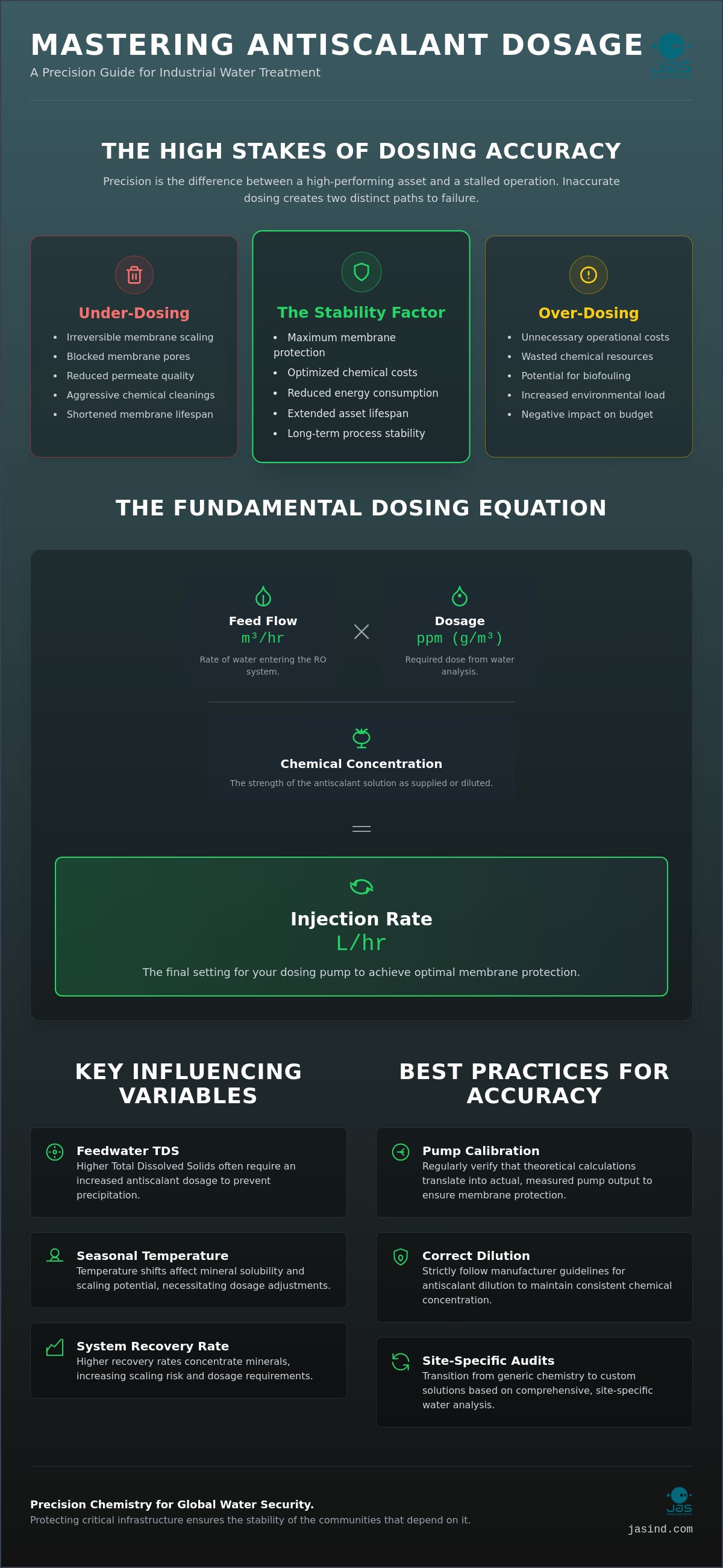
Inaccurate dosing creates two distinct paths to failure. Under-dosing leads to irreversible membrane scaling. Once minerals precipitate, they physically block the pores of the membrane, reducing permeate quality and requiring aggressive chemical cleanings. These cleanings often shorten the membrane's usable life. Conversely, over-dosing introduces its own set of risks. Excessive chemical presence can contribute to biofouling and represents unnecessary operational expenditure. Achieving the "Stability Factor" requires balancing chemical saturation limits with the high-recovery goals of your system. It's a matter of operational maturity and financial discipline.
Antiscalants in the Context of Global Water Security
The role of these chemicals extends far beyond the factory floor. In large-scale desalination plants, optimized chemistry is a prerequisite for sustainability. By preventing scale, these reagents allow systems to operate at higher recovery rates with a smaller environmental footprint. This is why we view industrial water treatment as a strategic resource for global stability. When you learn how to calculate antiscalant dosage with precision, you contribute to a more resilient and resource-secure world. Protecting our water infrastructure ensures the stability of the communities that depend on it.
Step-by-Step Methodology for Calculating Antiscalant Injection Rates
Relying on automated calculators can often obscure the underlying logic of your water treatment process. To maintain full control over your facility's operational integrity, you must understand the manual math behind chemical injection. This process begins with identifying four critical variables: feed flow rate, required dosage, dosing pump capacity, and chemical concentration. By mastering these inputs, you can ensure that your system receives the exact protection it requires without excess waste. Learning how to calculate antiscalant dosage is the first step toward achieving this level of industrial discipline.
The standard RO antiscalant dosage formula for determining the injection rate in liters per hour (L/hr) is: (Feed Flow × Dosage) / (Chemical Concentration). Consistency is the foundation of this calculation. If your feed flow is measured in m³/hr, your dosage must be in g/m³, which is equivalent to mg/L or ppm, to yield a clean result. Mixing units like GPM with mg/L without applying the proper conversion factors is a common source of calculation errors. These errors often lead to rapid membrane scaling and avoidable downtime.
The Fundamental Dosing Equation
The chemical injection rate is governed by a mass balance equation where the mass of the reagent injected must equal the mass required by the feedwater stream. First, you must determine the required dosage in ppm based on a comprehensive water analysis. Next, calculate the total mass flow of the chemical needed per hour by multiplying the feed flow by the target dosage. Finally, you must adjust this value for the specific gravity of the product. Most industrial antiscalants have a specific gravity between 1.10 and 1.45; ignoring this density factor will result in an under-dosed system. Precision in this step is vital for the security of your filtration assets.
Adjusting for Dilution in Day Tanks
Many facilities prefer to dilute "neat" chemicals in a day tank to improve dosing accuracy, especially at low flow rates. When you mix concentrated Water Treatment Antiscalants with permeate water, you must calculate a Dilution Factor. This factor is the ratio of the total volume in the tank to the volume of the neat chemical added. You'll then multiply your initial L/hr requirement by this factor to find the new pump setting. Once the volume is determined, you can adjust your pump stroke and frequency to match the calculated output. Always verify these theoretical settings using a calibration column to ensure the physical pump performance aligns with your mathematical model. Knowing how to calculate antiscalant dosage for both neat and diluted scenarios ensures your process remains stable regardless of feed variations.
Key Variables Influencing Scale Inhibition and Dosage Requirements
The mathematical framework established in the previous section provides the structure for your injection rates. However, the specific dosage variable (mg/L) is not a static number. It is a dynamic response to the complex chemistry of your feedwater. Understanding the environmental and operational factors that drive mineral precipitation is essential for process stability. When you evaluate how to calculate antiscalant dosage, you must first account for the variables that dictate the saturation limits of your specific water source.
Feedwater Total Dissolved Solids (TDS) and system recovery rates are the primary drivers of scaling risk. As a reverse osmosis system recovers pure water, the remaining ions are concentrated in the reject stream. For instance, a system operating at 75% recovery concentrates scaling ions fourfold. This exponential increase in concentration can quickly push minerals past their solubility limits. Temperature also plays a critical, often counterintuitive role. Unlike most substances, calcium carbonate becomes less soluble as temperatures rise, meaning seasonal shifts in feedwater temperature may require immediate adjustments to your chemical feed rates.
Saturation Indices: LSI and S&DSI
To determine the correct ppm for your injection formula, you must utilize standardized saturation indices. For brackish water RO systems, the Langelier Saturation Index (LSI) provides a calculated indicator of calcium carbonate's tendency to scale or dissolve. In high-salinity seawater applications, the Stiff & Davis Stability Index (S&DSI) is used to account for the "salt effect" on mineral solubility. These indices act as a compass for your treatment strategy. A positive index value indicates a scaling tendency, which directly dictates the required concentration of antiscalant needed to maintain mineral suspension. Integrating these calculations into your routine ensures the security of your membranes against unforeseen chemical shifts.
Critical Scaling Ions to Monitor
Effective scale inhibition requires a precise focus on specific problematic ions. Calcium Carbonate (CaCO3) is the most common foulant, but Calcium Sulfate (CaSO4) presents a greater challenge because it's significantly harder to remove during cleaning cycles. In arid regions, silica scaling often becomes the limiting factor for system recovery, requiring specialized antiscalant formulations. You must also monitor "low solubility traps" such as Barium and Strontium sulfates. Even at trace concentrations, these minerals can precipitate rapidly, causing irreversible damage to the membrane structure. By identifying these specific threats, you can refine how to calculate antiscalant dosage to address the highest risks first, ensuring long term operational reliability.
Best Practices for Antiscalant Dilution and Dosing Pump Calibration
Precision in theory must be matched by precision in practice. Even when you master how to calculate antiscalant dosage with mathematical certainty, the physical delivery system remains the final safeguard for your membranes. The bridge between a formula and a protected system is the dosing hardware. Selecting the right pump is your first technical decision. Diaphragm pumps are the industry standard for high pressure reverse osmosis applications due to their superior accuracy and ability to handle consistent backpressure. Conversely, peristaltic pumps are often preferred for highly viscous reagents or when ease of maintenance is the primary operational concern.
The quality of your dilution water is a non-negotiable factor in process stability. You must always use RO permeate for dilution. Using raw or partially treated water introduces scaling ions into the dosing tank itself, leading to "auto-scaling" and pump blockages. This internal precipitation can compromise the chemical's effectiveness before it ever reaches the feed stream. To secure your system against these scaling risks, explore our high-performance Water Treatment Antiscalants designed for industrial stability.
Calibrating the Dosing System
Technicians should perform a 60-second draw-down test weekly to verify actual pump output. This involves drawing the chemical from a graduated calibration column rather than the main tank for exactly one minute. You then compare this volume to your theoretical calculation. In different climates, you must account for viscosity changes. A chemical that flows freely in the Middle East may thicken significantly in European winter conditions, requiring a stroke adjustment to maintain the correct mass flow. Finally, ensure the injection point is designed for "Flash Mixing." The reagent must be uniformly distributed across the feedwater stream before it reaches the first membrane element to prevent localized scaling.
Common Dosing Errors to Avoid
One of the most frequent operational failures is "slug dosing," which occurs when a pump's frequency is set too low. This creates pulses of high-concentration chemical followed by periods of no protection. You should aim for a higher frequency and a shorter stroke to ensure a continuous, steady feed. Furthermore, be vigilant about chemical incompatibility. Anionic antiscalants can react violently with cationic coagulants used upstream, forming a sticky "goop" that fouls membranes instantly. Understanding these reagent interactions is critical, especially in complex environments where Mining Flocculants and other processing chemicals are used in tandem. Consistent logging of daily chemical draw-down provides the data needed to catch these errors before they lead to infrastructure damage.
Optimizing Process Efficiency with Tailor-Made Antiscalant Solutions
The mathematical frameworks and calibration techniques established in this manual provide the foundation for operational control. However, true efficiency requires looking beyond standard variables. Relying solely on generic reagents often leads to sub-optimal results in high-fouling or complex feedwater environments. Transitioning to custom-formulated chemistry ensures that your specific mineral profile is addressed with surgical precision. This evolution from standard applications to site-specific solutions is essential for reducing the total cost of ownership. By conducting a thorough technical audit, you can identify hidden inefficiencies that simple calculations might miss.
JAS Global Industries brings a legacy of innovation to these industrial challenges. Our expertise extends across critical sectors, providing advanced mining solutions and water treatment technologies that safeguard the stability of global resources. We don't just provide chemicals; we provide infrastructure security. When you master how to calculate antiscalant dosage, you possess the tools for daily management. When you partner with us for professional laboratory analysis, you gain the data needed for precise dosage modeling that accounts for every unique ion in your feedwater stream.
Beyond the Formula: The JAS Approach
Our methodology focuses on developing tailor-made formulations for the world's most demanding environments. We operate research and innovation centers that translate complex water chemistry into stable, high-recovery processes. This global technical support network ensures that on-site troubleshooting and process optimization are always available to our partners. We view chemical efficiency as a form of global responsibility. By optimizing your dosage, we reduce chemical discharge and energy consumption, contributing to a more sustainable and resource-secure industrial future.
Next Steps for Plant Managers
Achieving process maturity is a continuous journey of assessment and refinement. Start by auditing your current dosing rates against the mathematical models established in the previous sections. If you identify discrepancies or persistent fouling issues, it's time for a deeper technical review. Consult with a JAS specialist to conduct a comprehensive water chemistry analysis and performance audit. This professional oversight ensures that your facility operates at the peak of its potential while maintaining the security of your filtration assets.
Optimize your water treatment process with JAS Global Industries and secure the long-term stability of your critical infrastructure. Understanding how to calculate antiscalant dosage is the first step toward a partnership defined by reliability and technical excellence.
Securing Your Infrastructure Through Chemical Precision
Mastering how to calculate antiscalant dosage is more than a technical exercise; it's a fundamental commitment to the longevity of your industrial assets. You've explored the essential formulas and the critical environmental variables that dictate mineral saturation limits. True process optimization requires balancing these mathematical models with rigorous hardware calibration and site-specific chemistry. By applying these principles, you ensure the security of your membranes and the sustained efficiency of your water treatment operations. Protecting these resources is vital for both your operational budget and global infrastructure stability.
Since 1998, JAS Global Industries has served global industries as a reliable partner in resource protection. We maintain specialized R&I centers dedicated to custom chemical formulation and provide expert technical consulting for process optimization. Our team is ready to help you transition from generic reagents to tailor-made solutions that maximize process stability and reliability. Partner with JAS Global Industries for Advanced Water Treatment Solutions to secure your facility's future and enhance your operational maturity. Your pursuit of technical excellence is the foundation of a more sustainable and resource-secure world.
Frequently Asked Questions
What is the typical dosage range for RO antiscalants?
The standard concentration for antiscalants in reverse osmosis systems typically ranges between 5 and 20 parts per million (ppm). This specific range serves as a baseline; however, your actual requirement depends on site-specific water chemistry and recovery targets. Precise analysis is required to ensure you don't fall outside these boundaries, which could compromise membrane security and process stability.
Can I use tap water to dilute my antiscalant?
You should never use tap water to dilute your chemical reagents. Tap water contains hardness ions and residual chlorine that can react with the antiscalant, causing precipitation inside the dosing tank. Always use RO permeate to maintain the chemical's integrity and prevent "auto-scaling" within your injection system. This practice ensures the reagent remains fully active before entering the feed stream.
How does specific gravity affect antiscalant dosage calculations?
Specific gravity is a critical density factor that converts the mass of the chemical into a pumpable volume. Most industrial antiscalants have a specific gravity between 1.10 and 1.45. If you ignore this variable when learning how to calculate antiscalant dosage, your pump will deliver the wrong volume. This error leads to a significant under-dose or over-dose, threatening the stability of your filtration assets.
What happens if I over-dose antiscalant in my RO system?
Over-dosing can lead to chemical biofouling and unnecessary operational costs. Excessive polymers can act as a nutrient source for bacteria or physically foul the membrane surface by creating a sticky layer. This creates a paradoxical situation where too much protection actually reduces the lifespan of your membranes and increases the frequency of required cleanings.
How often should I recalibrate my antiscalant dosing pump?
You should recalibrate your dosing pumps at least once a month or whenever there's a significant change in feedwater temperature. Weekly draw-down tests are recommended for high-capacity systems to ensure consistent performance. Regular verification ensures that your theoretical calculations match the physical delivery of the reagent, providing a reliable safeguard against scaling and infrastructure damage.
Do antiscalants expire or lose effectiveness over time?
Industrial antiscalants typically have a shelf life of 12 to 24 months when stored in a controlled environment. Over time, the active polymers may degrade, reducing their ability to inhibit crystal growth effectively. Always check the manufacturer's expiration date and store chemicals away from direct sunlight to ensure your system remains fully protected against mineral precipitation.
Is antiscalant dosage different for seawater vs. brackish water?
Yes, the chemistry required for seawater is significantly different from brackish water due to higher ionic strength. Seawater systems face greater risks from sulfate scales and require different saturation indices, such as the Stiff & Davis Stability Index. Understanding how to calculate antiscalant dosage for these distinct environments is essential for maintaining the reliability of global desalination infrastructure.
Can antiscalant dosage be automated based on feedwater conductivity?
Modern systems can automate chemical injection by linking dosing pumps to feedwater conductivity sensors or flow meters. This smart dosing approach allows for real-time adjustments as water quality fluctuates throughout the day. While automation improves process efficiency, manual verification of the dosing logic remains a vital responsibility for plant managers to ensure long-term system security.