


Milling circuits consume over 3% of the world's electrical energy production annually. For global mining operations, finding a reliable grinding aid for mineral processing is no longer optional; it's a requirement for resource security. You likely face the daily pressure of managing high slurry viscosity that limits your mill throughput. It's common to worry that introducing chemicals early in the process might interfere with downstream flotation recovery. These concerns are valid and reflect the delicate balance required in modern mineral extraction.
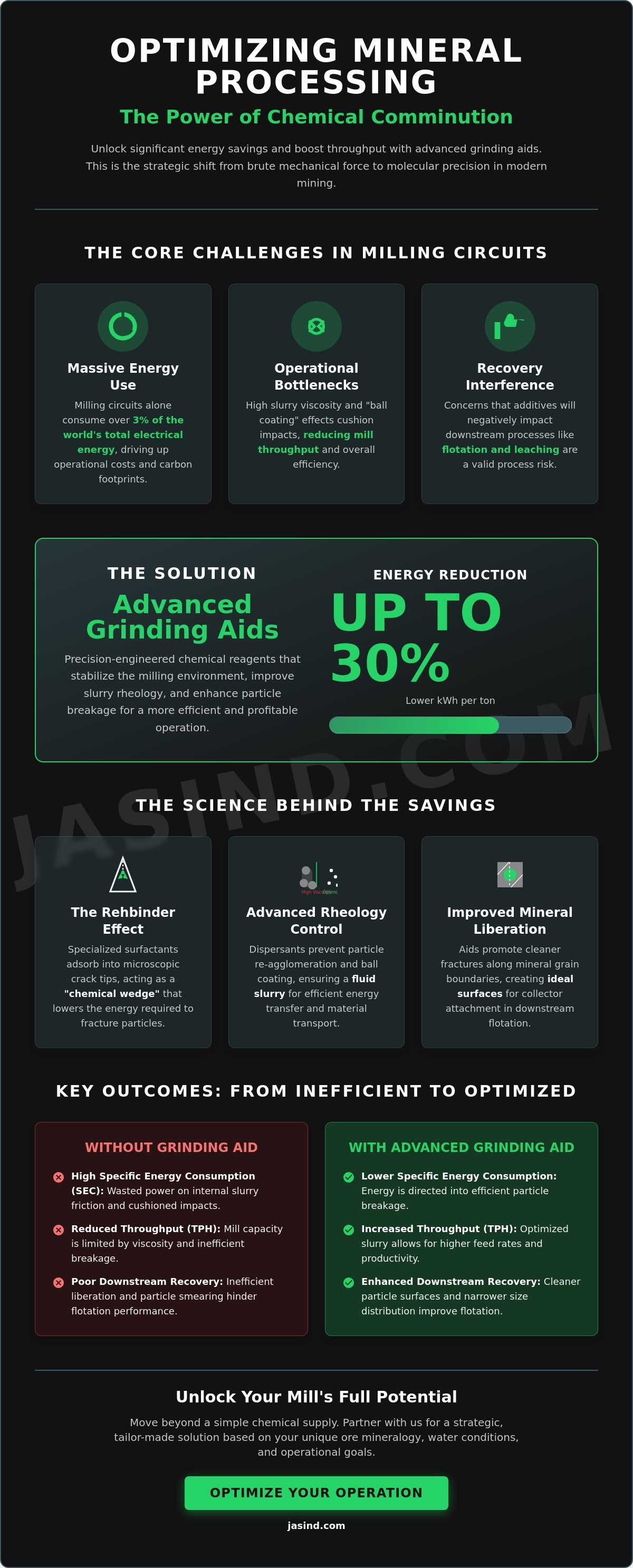
Implementing a high-performance additive is a strategic step toward optimizing your entire value chain. These chemical solutions don't just reduce energy consumption by up to 30%; they act as precision rheology modifiers that stabilize the grinding environment. This article explores how specialized aids lower your kWh per ton and ensure a narrower particle size distribution. You'll discover how to achieve optimized circuit stability and improve throughput while protecting the integrity of your downstream recovery processes.
Key Takeaways
- Learn how the Rehbinder Effect and advanced surfactants prevent particle re-agglomeration to overcome the energy barriers inherent in modern comminution.
- Discover how a specialized grinding aid for mineral processing can improve downstream flotation recovery by ensuring cleaner mineral surfaces for collector attachment.
- Understand the necessity of matching reagent chemistry to specific ore mineralogy and water conditions to ensure long-term circuit stability and resource security.
- Explore how technical audits and on-site testing transform chemical supply into a strategic partnership focused on optimizing your operation's total value chain.
Understanding Grinding Aids in Modern Mineral Processing
Comminution represents the most energy-intensive phase of any mining operation. It accounts for a substantial portion of total site power consumption. A grinding aid for mineral processing acts as a specialized chemical reagent designed to break this inherent energy barrier. These additives are no longer just performance enhancers; they're essential stabilizers for critical resource chains. The industry has evolved from utilizing basic glycols to deploying sophisticated, tailor-made formulations that address the unique mineralogy of each ore body. This shift marks the rise of "Chemical Comminution," a strategy that prioritizes molecular efficiency over raw mechanical force. It's a fundamental move toward industrial maturity and operational security.
The Economic and Environmental Imperative
Global mining hubs face unprecedented energy volatility. This reality makes grinding efficiency a cornerstone of global resource security. High specific energy consumption (SEC) directly inflates the carbon footprint of every ton of concentrate produced. By integrating advanced chemical aids, operators can reduce energy consumption by up to 30%. This reduction isn't just a cost-saving measure. It's a commitment to industrial sustainability and long-term value. Protecting these resources requires a steady, authoritative approach to process optimization. When we lower the kWh per ton, we don't just improve margins; we protect the stability of modern infrastructure.
Key Functions: Beyond Simple Size Reduction
The Science of Comminution involves complex interactions between mechanical impact and material resistance. Grinding aids provide a multi-layered solution to these challenges by modifying the physical properties of the slurry. They act as vital guardians of the milling circuit, ensuring that energy is directed toward particle breakage rather than wasted on internal friction.
- Increasing Throughput: Optimized reagents accelerate the rate of breakage, which directly boosts tons per hour (TPH) without requiring additional capital expenditure.
- Rheology Control: These chemicals manage slurry viscosity. They prevent the "ball coating" effect where fine particles stick to grinding media and cushion impacts.
- Enhanced Liberation: Precision chemistry promotes cleaner fracture lines. This improves the separation of valuable minerals from gangue during downstream stages.
Reliability is built on technical expertise. Modern mineral processing demands reagents that function with categorical precision. By addressing the fundamental needs of the milling circuit, these aids ensure both operational stability and long-term industrial health. We treat each mill as a unique ecosystem that requires specific chemical protection to thrive.
The Science of Comminution: How Chemical Additives Break the Energy Barrier
Breaking mineral structures requires overcoming significant atomic forces. While mechanical impact provides the force, a grinding aid for mineral processing provides the chemical leverage needed to facilitate fracture. This leverage transforms the milling environment from a high-resistance chamber into a streamlined production circuit. By manipulating the interface between solid particles and the surrounding fluid, these reagents ensure that every strike from the grinding media results in maximum breakage. It's a strategic shift from relying on brute force to utilizing molecular precision.
Surface Energy and Fracture Mechanics
Modern comminution relies on the strategic adsorption of molecules at the microscopic crack tips of mineral particles. As these molecules penetrate the fracture zone, they lower the energy required to propagate the crack. This transition is vital when moving from dry grinding applications, where dust suppression is the priority, to wet grinding environments that demand precise viscosity control. The Rehbinder effect defines the reduction in a solid's fracture resistance through the adsorption of surfactants at the crack tip. This chemical "wedging" action prevents the crack from closing, allowing the particle to split with less mechanical input.
Viscosity Control and Slurry Flow
High-density slurries often exhibit non-Newtonian behavior. This creates a thick, resistant environment that cushions the impact of grinding media and slows down the transport of material through the mill. Dispersants within the grinding aid maintain particle separation by creating electrostatic or steric repulsion between fine grains. This allows for higher solids loading without sacrificing flow efficiency. It also has a profound impact on the longevity of Grinding Media in Ball Mills. By preventing the buildup of a sticky particle layer on the media, the chemicals ensure metal-on-rock contact rather than metal-on-slurry cushioning, which significantly reduces wear rates.
The ultimate goal of this chemical intervention is a narrow particle size distribution (PSD). A tighter PSD prevents the production of ultra-fines that often escape downstream recovery while ensuring that no over-sized particles remain to clog the circuit. This level of control is essential for the stability of global resource extraction. Selecting the right mining chemical solutions ensures your operation maintains this critical balance between throughput and precision.
Beyond the Mill: Evaluating Downstream Effects on Flotation and Leaching
The most persistent concern among plant metallurgists is whether a grinding aid for mineral processing will act as a poison in the flotation circuit. This fear stems from the risk of competitive adsorption, where the grinding reagent might occupy the mineral surface sites intended for collectors. Protecting the integrity of the downstream process is a primary responsibility for any chemical supplier. Modern reagents are no longer blunt instruments; they are precision-engineered to be downstream-neutral or, in many cases, downstream-positive. By ensuring cleaner mineral surfaces and preventing the re-attachment of fine gangue, these aids actually stabilize the flotation environment.
The Interaction with Flotation Reagents
The relationship between comminution chemistry and separation efficiency is a critical pillar of operational stability. Research into Downstream Effects on Flotation indicates that properly selected aids do not impede collector attachment. Instead, they facilitate a more selective separation. In complex polymetallic circuits, the choice of reagent requires a balanced approach. While some traditional aids might increase froth stability excessively, specialized JAS formulations maintain the delicate balance required for high-grade concentrate production. These solutions are designed to degrade or remain in the aqueous phase, leaving the mineral surfaces ready for collector interaction.
- Pros: Cleaner mineral surfaces, reduced slime coating, and more consistent particle size for bubble-particle attachment.
- Cons: Potential for over-frothing if dosing isn't controlled or if the chemical structure is incompatible with existing frothers.
In magnetite and hematite circuits, we often see a "Polysaccharide Advantage." These organic-based aids serve a dual purpose. They reduce slurry viscosity in the mill and act as selective depressants for silica during flotation. This dual-functionality provides a significant boost to both throughput and final product grade.
Impact on Leaching and Extraction
For gold and copper operations, the benefits of advanced grinding extend directly into the leaching tanks. Better grinding efficiency creates a higher available surface area, which improves leaching kinetics and overall metal recovery. By preventing the "slime coating" of valuable minerals, reagents ensure that cyanide or acid solutions can penetrate the ore more effectively. This protection of the mineral surface is essential for maximizing the value of every ton processed. You can explore the foundational benefits of these additives in our guide on Mining Grinding Aids: Reducing Energy Consumption. Beyond the tanks, rheology control in the mill also improves downstream thickening and filtration. A more uniform particle size distribution leads to faster settling rates and drier filter cakes, which enhances the overall stability of the tailings management system.
Strategic Selection: Matching Grinding Chemistry to Ore Mineralogy
Every ore body presents a unique chemical puzzle. Selecting an effective grinding aid for mineral processing requires more than a standard reagent; it demands a deep understanding of specific mineralogy. Generic glycols often fail to account for the complex interactions between the ore, the process water, and the grinding media. We prioritize formulated solutions over simple, off-the-shelf chemicals to ensure categorical precision. This approach ensures that every mill operates at its peak potential while protecting the stability of the entire circuit.
Water chemistry is a vital factor in reagent performance. High salinity or extreme pH levels can deactivate standard grinding aids or cause unexpected precipitation. We analyze your specific water profile to ensure that our formulations remain chemically stable and active. Reliability in mineral processing depends on this level of technical foresight. It's the difference between a transactional supply and a long-term industrial partnership.
Phosphate and Potash Processing
Phosphate and potash sectors often contend with clay-heavy ores that create high-viscosity slurries. These conditions can stall production and increase energy costs. We provide specialized Phosphate Mining Chemicals and Potash Mining Chemicals that are specifically optimized to manage these high-viscosity environments. Managing air entrainment is also a priority in these circuits. We often integrate defoamers within the grinding stage to maintain slurry density and prevent pump cavitation. This level of protection ensures that your operation remains efficient even when processing the most challenging ore grades.
Metallic Ores: Gold, Copper, and Iron
In metallic circuits, the objective is precise liberation without the risk of over-grinding. Producing excessive "slimes" leads to significant metal loss in downstream recovery. Our strategy focuses on maximizing mineral release while preserving the integrity of the particle size distribution. In alkaline circuits, pH modifiers act as essential co-grinding aids. They stabilize the slurry rheology while preparing the mineral surfaces for the next stage of beneficiation. Custom dosing strategies prevent reagent waste and ensure that chemical inputs are always balanced against real-time throughput requirements.
We don't guess; we verify through a laboratory-scale grinding audit. This process involves testing various formulations against your site-specific ore samples to measure breakage rates and energy savings. This data-driven approach transforms chemical supply into a strategic advantage for your operation. Selecting the right mining chemical solutions provides the security needed to operate on a massive scale with absolute confidence.
Collaborative Innovation: Tailor-Made Grinding Solutions from JAS Global
JAS Global Industries serves as a vital guardian of industrial efficiency. We recognize that a high-performance grinding aid for mineral processing is the foundation of a stable extraction circuit. Our role extends far beyond chemical manufacturing. We provide the technical expertise required to secure global resources through smarter, more sustainable comminution strategies. Decades of established trust allow us to act as an indispensable pillar for modern mining infrastructure. We don't just sell reagents; we provide the chemical security needed to maintain global supply chains. Our commitment to excellence ensures that your operation remains resilient in a volatile global market.
The JAS Technical Audit Process
Efficiency isn't found in a catalog; it's discovered on the plant floor. Our engineers conduct comprehensive on-site troubleshooting to identify hidden bottlenecks in your grinding circuit. This process involves rigorous sampling and laboratory testing to analyze the specific response of your ore to various chemical formulations. We evaluate mill throughput, specific energy consumption, and the downstream recovery metrics discussed earlier. We don't believe in generic supply. Instead, we develop tailor-made reagents that address the unique mineralogical and rheological challenges of your site. This transition from bulk reagent supply to a "Partnership for Efficiency" ensures that your operation achieves its desired outcomes with categorical precision. We focus on delivering measurable results: lowering energy costs, stabilizing slurry flow, and protecting mineral surfaces.
Global Reach and Resource Security
Founded in 1998, JAS Global Industries has built a reputation rooted in reliability and corporate maturity. With our headquarters in Dubai and a strategic presence across Asia and Europe, we provide the logistics reliability essential for large-scale industrial operations. We prioritize long-term value over transactional agreements. This global reach ensures that our partners have access to the latest sustainable, cost-effective chemical technologies regardless of their location. Our formulations emphasize environmental responsibility by utilizing low-VOC and non-chloride-based components whenever possible. We treat every partnership as a commitment to the broader human impact of technical excellence. Protecting resources. Optimizing circuits. This is the dual mission that drives our global operations. We stand ready to help you navigate the complexities of modern mineral beneficiation with confidence and technical authority.
Optimize your mineral processing circuit with a JAS technical audit.
Securing the Future of Mineral Efficiency
Optimizing your milling circuit is a fundamental step toward long-term industrial stability. By integrating a specialized grinding aid for mineral processing, you move beyond basic cost savings to achieve true process security. This journey requires a balance of molecular science and operational expertise to ensure that increased throughput never compromises downstream recovery. Protecting the integrity of your mineral surfaces is essential for maximizing the value of every ton extracted from the earth.
Since 1998, JAS Global Industries has served as a reliable partner for the world's most critical mining operations. Our multiple R&I centers globally allow us to develop specialized formulations for challenging sectors like Phosphate and Potash. We focus on long-term value and the broader human impact of our technical solutions. We act as a foundational industry presence, ensuring that your technical challenges are met with wisdom and precision.
Consult with our Metallurgy Experts for a Custom Grinding Audit to redefine your circuit's potential. Your commitment to efficiency today builds the foundation for a more sustainable and productive tomorrow.
Frequently Asked Questions
What is the primary mechanism of a grinding aid in mineral processing?
A grinding aid for mineral processing works by reducing the surface energy of particles and modifying slurry rheology. This dual action facilitates crack propagation through the Rehbinder effect while preventing fine particles from re-agglomerating. By maintaining a lower viscosity, the chemical ensures that the grinding media can impact the ore directly rather than being cushioned by a thick, sticky layer of fines.
Can grinding aids reduce the consumption of grinding media like steel balls?
Yes, these chemicals significantly extend the life of grinding media by preventing ball coating. When fine particles adhere to the surface of steel balls, they cushion impacts and waste energy. By keeping the media clean, the aids ensure efficient rock-to-metal contact. This reduction in cushioning minimizes the abrasive and corrosive wear that typically degrades grinding balls over time.
Do grinding aids negatively impact the downstream flotation of copper or gold?
Properly formulated aids don't interfere with collectors and can actually improve recovery rates. They prevent slime coating, where ultra-fine gangue particles stick to valuable mineral surfaces and block collector attachment. By ensuring cleaner surfaces in the mill, these reagents prepare the ore for more selective and efficient separation in the flotation cells during copper or gold extraction.
How much energy can a typical mining operation save by using grinding aids?
Mining operations can reduce specific energy consumption by up to 30% depending on the mill type and ore mineralogy. Since comminution accounts for over 3% of global electrical energy use, these savings are vital for operational sustainability. Lowering the kWh per ton directly reduces the carbon footprint and operational costs of the entire beneficiation plant while protecting global energy resources.
Are there eco-friendly or "green" grinding aids available for modern mines?
How do I determine the correct dosage of a grinding aid for my specific ore?
Correct dosage is determined through a combination of laboratory-scale grinding audits and real-time plant trials. Engineers analyze the breakage rate and slurry viscosity across a range of concentrations to find the optimum balance. Over-dosing can lead to excessive frothing or reagent waste, so precise calibration based on specific ore mineralogy and water chemistry is essential for circuit stability.
What is the difference between a dispersant and a grinding aid?
While all grinding aids act as dispersants, not all dispersants facilitate the mechanical fracture of minerals. A dispersant primarily manages particle repulsion to control viscosity and flow within the slurry. A comprehensive grinding aid for mineral processing also includes surfactants that lower the physical strength of the mineral, making it easier to break during mechanical impact through reduced surface tension.
Can grinding aids help with moisture control in dry grinding circuits?
Grinding aids are highly effective in dry circuits for managing moisture-induced agglomeration. In environments with high humidity or damp feed, fine particles tend to stick together and coat the mill liners or grinding media. The chemical creates a protective layer that keeps particles separate and free-flowing. This ensures consistent throughput and prevents the mill from plugging or losing efficiency during operation.