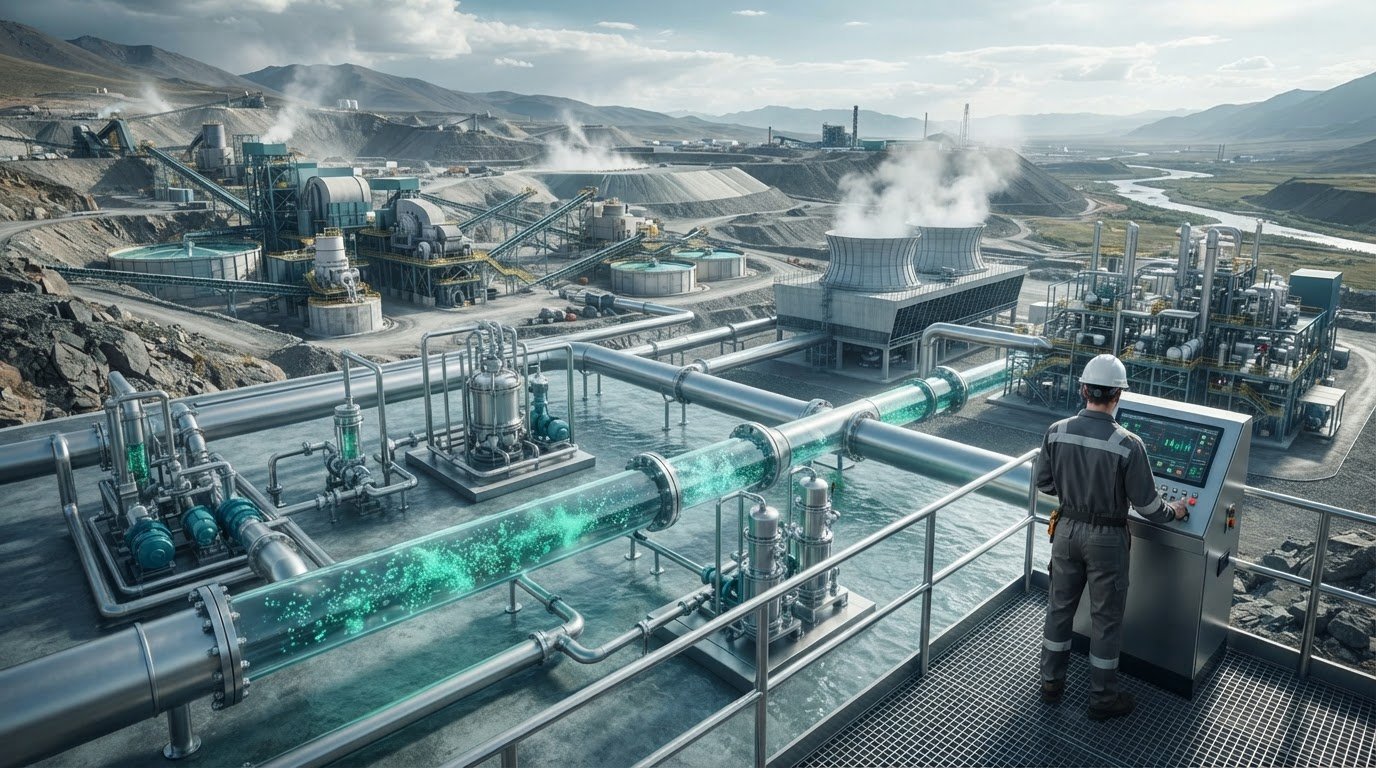


Can an industrial asset maintain 99% inhibition efficiency while meeting the most stringent 2026 environmental mandates? For decades, the sector has operated under the assumption that protecting critical infrastructure required a trade-off with ecological safety. You've likely felt the mounting pressure from the impending EU REACH revisions and the November 2026 CLP labeling deadlines. The uncertainty surrounding the shelf-life and stability of bio-based alternatives often makes the transition feel like a gamble with your most vital assets. We understand that reliability is the foundation of your operations.
Modern eco-friendly corrosion inhibitors have finally closed the performance gap, matching the strength of traditional chromates without the regulatory risk. This article explores how sustainable chemistry now provides a reliable shield for industrial infrastructure. We'll examine the technical breakthroughs ensuring global ESG compliance while reducing your total cost of ownership through advanced, stable formulations. Discover how to transition from legacy chemicals to high-performance green solutions that secure both your equipment and our shared environment.
Key Takeaways
- Analyze the transition from heavy-metal based inhibitors to sustainable alternatives that align with 2026 ESG mandates and Scope 3 emission goals.
- Explore the molecular mechanisms of eco-friendly corrosion inhibitors, focusing on how natural polymers provide anodic and cathodic protection for critical infrastructure.
- Evaluate technical performance through ZRA benchmarking to verify that green chemistry delivers the same inhibition efficiency as traditional synthetic options.
- Reduce the total cost of ownership by implementing non-toxic formulations that lower PPE requirements and streamline environmental compliance.
- Gain industry-specific insights for securing assets in mining and fertilizer production while maintaining the stability of global resource chains.
The Evolution of Corrosion Protection: Why Eco-Friendly Inhibitors are Essential in 2026
Global infrastructure serves as the foundation of modern society. When these systems fail, the stability of critical resources like water and energy is compromised. Historically, industrial maintenance relied on a Corrosion inhibitor formulated with hexavalent chromium, phosphates, or heavy metals. While effective, these substances pose significant risks to environmental security. In 2026, the industry is moving past the "toxic-but-effective" paradigm toward eco-friendly corrosion inhibitors that prioritize both performance and protection. We don't just maintain equipment; we safeguard the future of industrial operations.
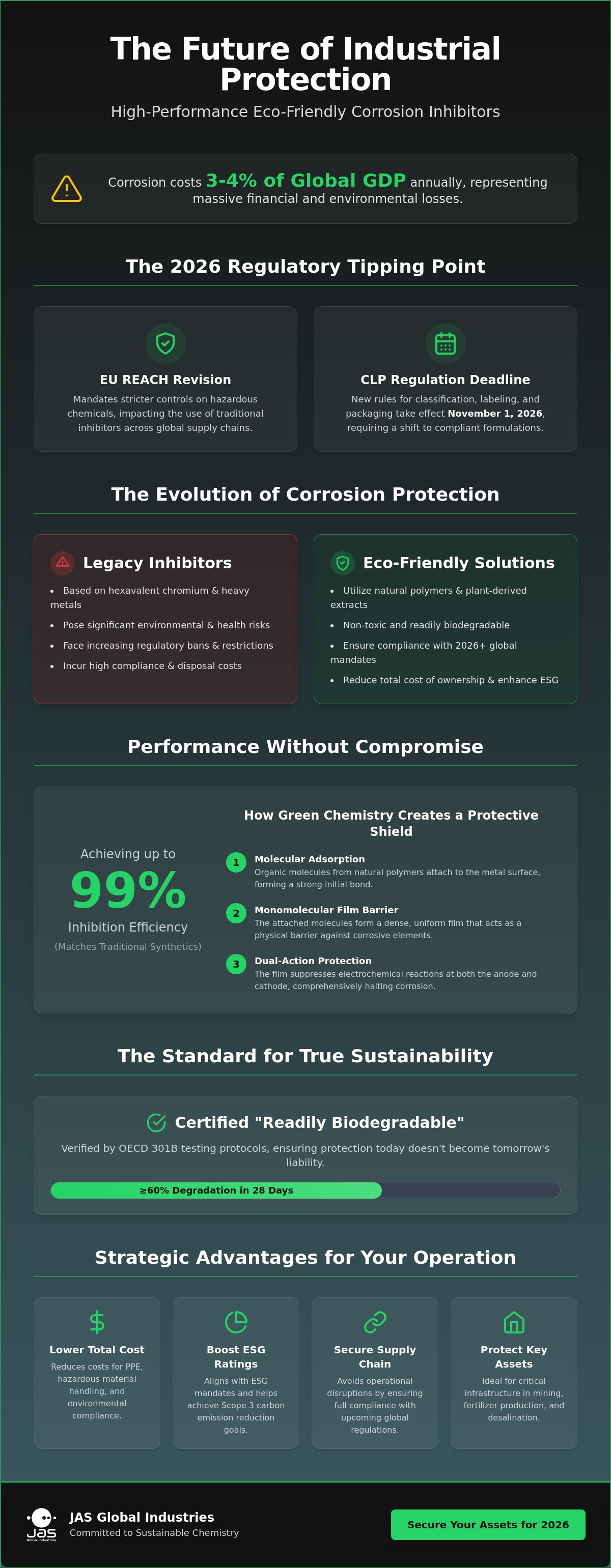
The cost of inaction is staggering. Industry data indicates that corrosion costs between 3% and 4% of global GDP annually. These losses aren't just financial. They represent wasted resources, increased carbon footprints, and potential environmental disasters. Corporate responsibility now dictates that corrosion management must align with ESG ratings. Procurement decisions directly impact Scope 3 emissions. By selecting sustainable chemistry, organizations demonstrate a commitment to global guardianship. They move from being mere operators to becoming responsible corporate citizens who protect both their assets and the communities they serve.
Regulatory Drivers in the Middle East and Europe
The second half of 2026 represents a definitive tipping point for chemical procurement. The long-awaited EU REACH revision is finally arriving, alongside the November 1, 2026 deadline for compliance with the updated CLP Regulation. These mandates aren't just European concerns. In the Middle East, local environmental bodies are increasingly adopting these standards to protect desalination plants and energy infrastructure. Transitioning to eco-friendly corrosion inhibitors is no longer a voluntary ESG gesture. It's a requirement for operational continuity. Companies that ignore these shifts face legal risks and supply chain disruptions.
Defining "Eco-Friendly" in an Industrial Context
True sustainability in water treatment and mining requires a focus on the entire chemical lifecycle. It's not enough for a substance to have low toxicity. It must be biodegradable to prevent accumulation in sensitive ecosystems. We distinguish between simple bio-based products and high-performance industrial additives. In 2026, the industrial standard defines an eco-friendly inhibitor as a formulation that achieves "readily biodegradable" status by reaching at least 60% degradation within 28 days under OECD 301B testing protocols. This ensures that the protection we apply today doesn't become the environmental liability of tomorrow. Our focus remains on stability, safety, and the long-term health of global infrastructure.
The Mechanism of Sustainable Inhibition: How Green Formulations Protect Infrastructure
Sustainable protection relies on molecular precision. Eco-friendly corrosion inhibitors utilize sophisticated chemical interactions to shield metal surfaces from degradation. Unlike legacy synthetics that often rely on toxic passive layers, these green formulations primarily function through adsorption. This process involves organic molecules attaching to the metal substrate through specific polar groups. They create a dense, monomolecular film that acts as a physical barrier. This shield effectively blocks corrosive ions, such as chlorides and sulfates, from reaching the reactive metal surface. By focusing on the molecular level, we ensure the stability of the entire industrial asset.
The effectiveness of these inhibitors is rooted in their dual-action capability. Many plant-derived extracts and natural polymers provide both cathodic and anodic protection. They suppress the electrochemical reactions that drive metal loss at both the anode and the cathode. This comprehensive coverage is often enhanced by synergistic effects. By combining organic acids with eco-friendly surfactants, we improve surface wetting and ensure uniform film formation across complex geometries. This approach guarantees that even the most vulnerable components of a system remain secure.
Natural Polymers and Amino Acids as Building Blocks
Polyaspartic acid has emerged as a cornerstone of modern green chemistry. It is a biodegradable polypeptide that serves as an exceptional film-former in industrial water systems. While traditional phosphonates are under increasing regulatory scrutiny, carboxylates offer a stable, phosphorus-free alternative. In high-salinity environments, these amino acid derivatives provide robust protection for mild steel. They are particularly effective because they remain stable across a wide pH range. This reliability ensures that infrastructure remains protected even during operational fluctuations. Using these building blocks allows us to replace hazardous legacy chemicals with superior, sustainable alternatives.
Green Chemistry in High-Stress Environments
Protecting infrastructure in thermal desalination and reverse osmosis (RO) systems requires extreme chemical stability. High temperatures and fluctuating pressures can cause inferior molecules to degrade. Modern sustainable formulations maintain their molecular integrity in processes exceeding 80°C. It's essential that these inhibitors remain compatible with other system additives. Our eco-friendly corrosion inhibitors maintain high efficiency when used alongside biocides and antiscalants, preventing interference that could compromise mineral recovery or water quality. For a comprehensive look at how these chemicals integrate into broader facility management, refer to our Industrial Water Treatment Pillar.
Achieving 99% inhibition efficiency doesn't require a compromise on environmental security. The technical maturity of bio-based chemistry now matches the performance of traditional synthetics in the most demanding conditions. This reliability is why global leaders are increasingly turning to specialized water treatment corrosion inhibitors to secure their critical assets. By choosing chemistry that respects the natural lifecycle, industries protect their equipment and the global resources they manage.
Performance Benchmarking: Eco-Friendly vs. Traditional Synthetic Inhibitors
The transition to sustainable chemistry is often met with skepticism regarding technical efficacy. For years, the industry relied on chromates and phosphates because they provided a reliable shield. However, 2026 data confirms that eco-friendly corrosion inhibitors have reached parity with these legacy synthetics. Performance benchmarking through Zero Resistance Ammetry (ZRA) demonstrates that modern green formulations create a stable, non-porous film that effectively isolates the metal substrate from corrosive media. We've moved beyond the era of compromise. Reliability is now built into the molecular structure of sustainable protection.
Operational security extends beyond inhibition efficiency. It encompasses the safety of the workforce and the stability of the surrounding environment. Non-toxic inhibitors significantly reduce the total cost of ownership by lowering spill-management expenses and waste-disposal fees. While traditional chemicals require complex hazardous waste protocols, green alternatives simplify logistics. This shift also impacts personnel protection. Reduced PPE requirements create a safer, more efficient working environment for onsite teams. We view this as a holistic approach to infrastructure security.
System compatibility remains a primary concern for facility managers. Our experience shows that eco-friendly corrosion inhibitors integrate seamlessly with other essential specialty chemicals. They don't interfere with the performance of silicon-based defoamers or powder antifoams used in high-stress industrial circuits. This synergy ensures that protecting one part of the system doesn't compromise another. By maintaining chemical balance, we protect the integrity of the entire operation.
Debunking the "Low Efficiency" Myth
Outdated research often suggests that bio-based chemicals lack the strength for aggressive industrial fluids. Modern testing proves otherwise. In standard industrial cooling and process waters, these formulations consistently achieve inhibition efficiency (IE%) ratings exceeding 95%. Modern carboxylate-based inhibitors achieve an inhibition efficiency of over 95%, matching the performance of traditional chromates while eliminating their toxic profile. This level of protection ensures that mild steel and copper alloys remain secure even in high-salinity conditions.
Operational Reliability and Shelf-Life
Concerns regarding the microbial degradation of natural polymers are addressed through advanced stabilization. Professional-grade formulations utilize eco-friendly biocides to ensure a shelf-life comparable to traditional synthetics. These products remain stable during long-term storage in varied climates, from the Middle East to Southeast Asia. Integrating these solutions into comprehensive chemicals management plans allows for a seamless transition without disrupting existing maintenance schedules. We provide the technical certainty required to maintain global resource stability.
Implementation: Selecting Sustainable Inhibitors for Mining, Fertilizers, and Desalination
Effective implementation depends on precision. We don't just apply chemicals; we integrate them into complex industrial ecosystems. Eco-friendly corrosion inhibitors must perform under the unique stresses of mineral extraction, chemical synthesis, and water desalination. Proactive chemical protection replaces reactive maintenance. This approach secures the longevity of expensive capital equipment. It ensures that global resource chains remain stable and efficient. We prioritize the stability of your infrastructure as a pillar of global security.
In water treatment, the focus shifts to heat exchangers and membranes. Thermal desalination plants operate at high temperatures where traditional inhibitors often fail. Sustainable formulations protect these critical heat transfer surfaces without causing environmental harm during blowdown. For reverse osmosis (RO) systems, compatibility is essential. Our inhibitors protect high-pressure pumps and piping without fouling sensitive membranes. This dual focus on protection and performance maintains the continuous flow of fresh water to the communities that need it most.
Tailor-Made Formulations for Mineral Processing
Mining environments present extreme challenges for corrosion management. Inhibitors must protect grinding circuits and flotation cells without interfering with the delicate chemistry of mineral recovery. It's vital that these agents coexist with mining flotation collectors to maintain high grade and recovery rates. Chemical selection also impacts tailings management. By using biodegradable inhibitors, mines can improve the safety of water recycling processes and reduce the environmental footprint of their waste streams. We ensure that your pursuit of resources doesn't come at the expense of ecological stability.
Protecting Fertilizer Assets
Fertilizer production involves some of the most corrosive substances in industry. Phosphoric acid and ammonia plants require robust protection to prevent catastrophic asset failure. In these facilities, corrosion inhibitors often work alongside anti-caking agents to maintain both the equipment and the final product quality. High-temperature granulation and storage pose additional risks that require heat-stable, sustainable chemistry. We provide the technical expertise to ensure your complex fertilizer formulations remain stable from production to the field. Protecting these assets is essential for maintaining global food security.
Securing your infrastructure requires a long-term partnership built on technical trust. If you're ready to transition your facility to 2026 standards, you can consult with our experts on specialized industrial corrosion inhibitors. We'll help you select the right chemistry to protect your assets while meeting your ESG mandates.
Securing Global Infrastructure: The JAS Global Industries Commitment to Sustainable Chemistry
Stability is not a static state. It's the result of persistent, high-level chemical protection applied across the world's most demanding industrial environments. At JAS Global Industries, we view specialty chemicals as a foundational pillar of modern infrastructure. Our development of eco-friendly corrosion inhibitors isn't merely a response to market trends. It is a core part of our mission to act as a vital global guardian. We focus on the stability of critical resources, ensuring that the systems providing water, food, and energy remain operational for generations.
Global supply chain reliability is essential for maintaining this stability. We understand that a high-performance inhibitor is only valuable if it's available when and where it's needed. Our logistics network ensures consistent access to green chemistry across the Middle East, Africa, and Asia. We bridge the gap between advanced R&I and field application, providing a steady flow of essential additives to remote mining sites and complex desalination plants. This reliability is the foundation of the long-term partnerships we build with our industrial clients.
From Lab to Plant: Our Tailor-Made Solutions
Our Research and Innovation (R&I) centers don't operate in a vacuum. We simulate real-world plant conditions to ensure our formulations withstand regional challenges, from extreme thermal stress in the Gulf to high-salinity water in coastal mining operations. Professional technical audits are a central part of our service. Our experts conduct on-site dosing optimizations to ensure maximum inhibitor efficiency. This proactive approach reduces chemical waste and lowers the total cost of ownership. We partner with you to achieve operational excellence while securing the long-term health of your capital assets.
A Vision for Sustainable Industrial Growth
JAS Global Industries bridges the gap between industrial output and environmental ethics. We believe that protecting global water and food security requires a commitment to decarbonization and sustainable innovation. In August 2025, the Science Based Targets initiative (SBTi) validated our climate targets. We're committed to reducing our absolute scope 1 and 2 greenhouse gas emissions by 42% by 2030. Every application of our eco-friendly corrosion inhibitors contributes to this broader goal of industrial sustainability. Our role is to provide the chemical security necessary for a stable, prosperous, and responsible global economy.
Optimize your process efficiency with JAS Global Industries sustainable solutions.
Transitioning to a Secure and Sustainable Industrial Future
The landscape of industrial maintenance has shifted. Compliance with 2026 mandates is now a prerequisite for operational security. We've demonstrated that eco-friendly corrosion inhibitors don't just meet these standards; they match the performance of traditional synthetics in high-stress environments. Whether you're managing complex mining circuits or critical desalination heat exchangers, the technical certainty of green chemistry is proven. Protecting infrastructure is an essential act of global guardianship.
Since 1998, we've served the mining and fertilizer sectors with specialized chemical solutions. Our global R&I centers continue to develop bespoke formulations for the unique desalination challenges of the Middle East. You don't have to navigate this transition alone. Reliability is the foundation of our partnership. We provide the expertise needed to balance industrial output with environmental responsibility.
Consult with our technical experts to develop a sustainable corrosion protection strategy. Let's secure your assets and the environment together.
Frequently Asked Questions
What makes a corrosion inhibitor "eco-friendly" in industrial applications?
An industrial inhibitor is considered eco-friendly when it demonstrates low aquatic toxicity and high biodegradability. In 2026, the industry standard requires these formulations to be "readily biodegradable." This means they must achieve at least 60% degradation within 28 days under OECD 301B testing protocols. These products replace hazardous substances like hexavalent chromium and phosphates with natural polymers or organic acids that don't accumulate in the environment.
Can green corrosion inhibitors handle the high temperatures of thermal desalination?
Modern sustainable formulations are engineered for extreme thermal stability. They maintain their molecular integrity in desalination heat exchangers at temperatures exceeding 80°C. These inhibitors provide a robust physical barrier on metal surfaces without degrading into harmful byproducts. This reliability ensures that critical water infrastructure remains protected even in the harsh operating conditions typical of Middle East desalination plants.
How do sustainable inhibitors affect the performance of mining flotation circuits?
Professional-grade eco-friendly corrosion inhibitors are designed to be chemically compatible with mining flotation collectors. They don't interfere with the selective attachment of bubbles to mineral particles. This ensures that protecting grinding circuits and flotation cells doesn't compromise mineral recovery rates or final concentrate grade. Using biodegradable chemistry also simplifies the management of tailings and recycled process water.
Are eco-friendly corrosion inhibitors more expensive than traditional chemicals?
The total cost of ownership for sustainable inhibitors is often lower than traditional toxic alternatives. While initial chemical procurement costs might vary, organizations save significantly on hazardous waste disposal fees and spill-management protocols. Reduced requirements for specialized personal protective equipment (PPE) also improve operational efficiency. Transitioning to green chemistry is an investment in long-term infrastructure security and regulatory compliance.
What is the typical inhibition efficiency of modern bio-based formulations?
Modern eco-friendly corrosion inhibitors consistently achieve inhibition efficiency ratings of over 95% in standard industrial fluids. This performance matches the protection levels previously only available through traditional synthetic chemicals. Data-driven benchmarking through Zero Resistance Ammetry (ZRA) confirms that these green molecules create a dense, non-porous film. This shield effectively isolates the metal substrate from corrosive chlorides and sulfates in cooling and process waters.
Do green inhibitors require specialized equipment for dosing or application?
Most sustainable inhibitors are designed for seamless integration into existing chemical dosing systems. They don't require specialized hardware for application. However, we recommend professional technical audits to optimize dosing rates for your specific water chemistry. This precision ensures maximum efficiency and prevents chemical waste. Our experts help you calibrate your existing infrastructure to achieve peak performance with modern sustainable chemistry.
How do these chemicals contribute to a corporate ESG strategy?
Adopting sustainable corrosion protection directly supports ESG mandates by reducing Scope 3 emissions and enhancing environmental security. It demonstrates a commitment to responsible corporate citizenship and aligns with the 2026 EU REACH and CLP regulatory updates. By protecting infrastructure with non-toxic chemistry, companies safeguard the stability of global resources. This proactive approach builds trust with stakeholders and ensures long-term operational continuity.
What happens to the biodegradability of these inhibitors after they react with metal surfaces?
The molecules that adsorb onto the metal surface form a stable, protective film that remains in place during operation. Any residual inhibitor in the bulk water stream retains its biodegradable properties. This ensures that the chemical breaks down naturally after discharge or during water recycling processes. It prevents the long-term accumulation of synthetic polymers in local ecosystems, protecting the environment without compromising asset integrity.