

By the end of 2026, over 60% of new iron ore plants will rely on advanced automation to solve a recovery crisis that traditional chemistry can no longer manage. You've likely noticed that as high-grade reserves deplete, the remaining ore bodies are becoming increasingly complex and heavy with silica. Relying on standard starches, which currently cost between $416 and $701 per metric ton depending on your region, often leads to inconsistent performance and lost mineral value. Selecting the correct depressants for iron ore flotation is no longer just a procurement choice. It's a requirement for operational stability in a market where the global flotation chemicals sector is climbing toward a $12.8 billion valuation this year.
We recognize the challenge of maintaining high iron grades while reducing chemical consumption costs through better efficiency. This article explores how advanced chemical depressants enhance iron ore selectivity and secure the stability of global mineral supply chains. You'll discover the shift toward organic inhibitors like Carboxymethyl Cellulose, the impact of 2026 EPA regulatory updates, and the molecular strategies that reduce silica content to meet the world's strictest infrastructure standards.
Key Takeaways
- Learn how modern depressants for iron ore flotation serve as essential surface modifiers to protect iron minerals during complex reverse flotation processes.
- Understand the molecular mechanisms of adsorption and hydrogen bonding that transform iron surfaces into hydrophilic barriers against air bubbles.
- Compare the long-term value and precision of cellulose derivatives against the inherent limitations of traditional corn starch applications.
- Identify the critical thresholds for dosing to prevent accidental suppression of target minerals and maintain peak circuit efficiency.
- See how technical audits and bespoke chemical engineering stabilize mineral supply chains by addressing the unique challenges of specific ore bodies.
The Role of Depressants in Modern Iron Ore Beneficiation
Depressants are the silent architects of mineral purity. In the froth flotation process, these reagents act as selective surface modifiers. They identify and coat specific mineral surfaces to prevent them from attaching to air bubbles. They act as the security guard of the flotation cell. They decide which minerals exit through the froth and which remain in the slurry. For iron ore producers, depressants for iron ore flotation are essential for maintaining grade as global reserves shift toward lower-quality, complex deposits.
This shift isn't just a technical hurdle. It's a matter of global resource security. Efficient depression of iron oxides allows mines to extract value from material once labeled as waste. By enabling the beneficiation of low-grade ores, these chemicals protect the stability of the global steel supply chain. Without effective inhibitors, the industry couldn't meet the rigorous purity requirements of modern infrastructure development.
The Shift from Primary to Reverse Flotation
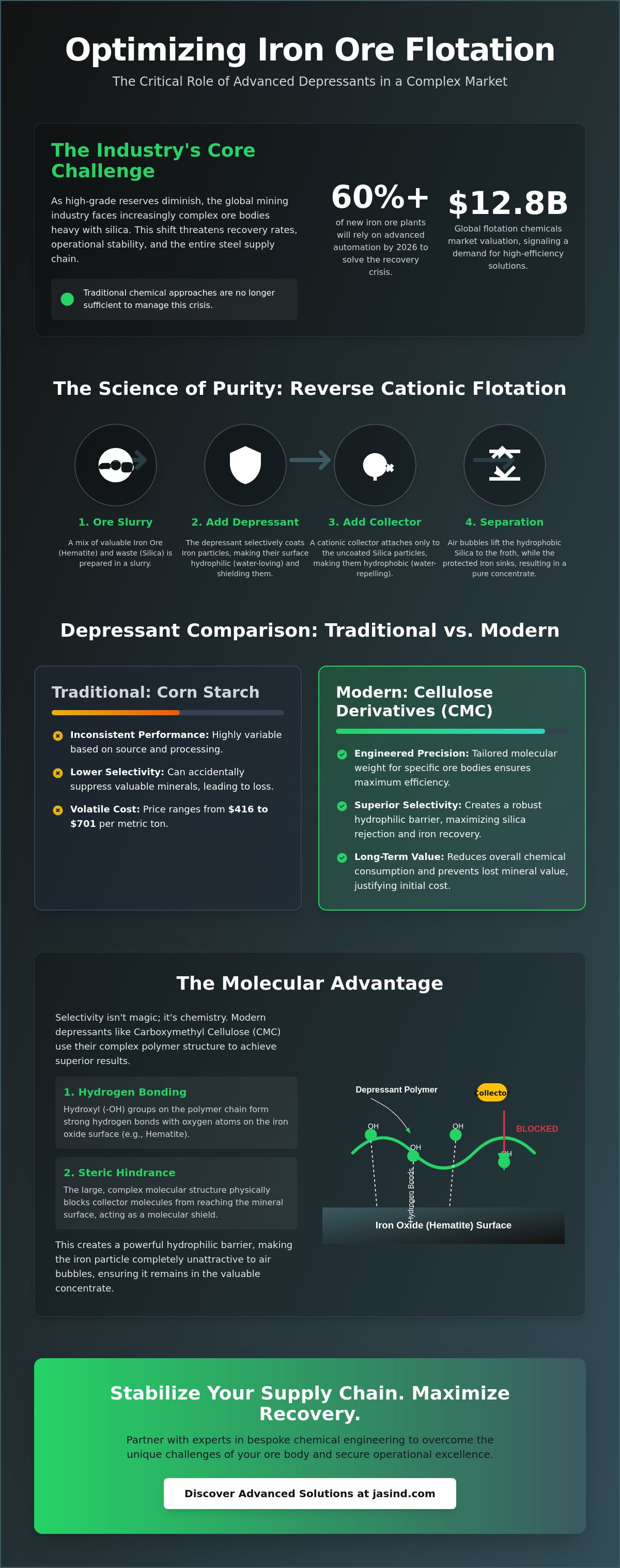
Reverse cationic flotation is the industry standard for iron. In this circuit, the goal is to float silica while valuable iron stays in the "sink" fraction. This process requires absolute precision. Depressants must effectively shield the iron oxide surfaces, usually hematite or magnetite, from the cationic collectors. If the depression fails, valuable iron is lost to the tailings. Maintaining a stable hematite sink is the primary defense against high silica contamination in the final concentrate.
Key Performance Indicators for Flotation Reagents
Metallurgists focus on selectivity indices and recovery rates to determine chemical efficiency. Choosing the right depressants for iron ore flotation directly impacts these metrics. High-performance reagents reduce the silica percentage without sacrificing iron recovery. This efficiency has a massive impact on downstream steelmaking. High-silica concentrates increase slag volume and coke consumption in blast furnaces, which drives up energy costs and emissions. Selectivity in iron flotation is the chemical's ability to maximize silica rejection while ensuring iron oxides remain entirely unresponsive to collector attachment.
Molecular Mechanisms: How Depressants Achieve Mineral Selectivity
Selectivity starts at the molecular level. It's a precise chemical dialogue. The adsorption of depressants for iron ore flotation occurs through two primary paths: hydrogen bonding and chemical interaction. Organic polymers, such as starches or cellulose derivatives, rely heavily on hydrogen bonding between their hydroxyl groups and the oxygen atoms on the mineral surface. This creates a robust, protective layer that resists the attachment of collectors.
This layer does more than just provide a physical barrier. It transforms the mineral's personality. By orienting polar groups toward the aqueous phase, the depressant creates a high-energy, hydrophilic surface. Air bubbles simply can't find a foothold. Instead of rising with the froth, the protected iron particles remain submerged in the slurry. This physical repulsion is the fundamental mechanism that secures iron recovery while impurities are stripped away.
Success depends on the chemical environment. The Point of Zero Charge (PZC) for hematite typically falls between pH 6.7 and 8.5. Most reverse flotation circuits operate in alkaline conditions to ensure the silica is properly collected. This environment influences the surface charge and the ionization of the reagent. It's a game of competitive adsorption. The depressant must win the race against cationic collectors for the active sites on the iron oxide. Molecular weight plays a critical role here. Larger polymeric chains provide better steric hindrance; they physically mask the mineral surface from the collector's reach.
Surface Chemistry of Hematite and Magnetite
Each ore body has a unique mineralogical signature. Hematite and magnetite respond differently to chemical modifiers based on their crystal structures. Effective depressants for iron ore flotation must be tailored to these specific active sites. By understanding the PZC of the specific deposit, engineers can adjust the chemical formulation to maximize masking efficiency. This prevents the accidental flotation of iron, which remains the primary cause of recovery loss in high-silica circuits.
The Role of Surfactants in Modifier Delivery
Chemical reagents must be distributed evenly to be effective. In high-solids slurries, reagent dispersion is a significant operational challenge. There is a powerful synergy between depressants and surfactant chemistry. Surfactants lower the surface tension and ensure the depressant reaches every mineral grain quickly. This improves the kinetics of the entire circuit. If you want to optimize your reagent suite, consider an expert technical audit of your flotation chemistry to identify these hidden synergies. Proper molecular structure dictates how fast the depression occurs, ensuring stability even during throughput surges.
Traditional vs. Modern Depressants: Evaluating Performance and Cost
The choice between legacy reagents and modern chemistry is a strategic decision for any mine operator. Corn starch remains the industry's traditional workhorse. It's accessible and has a low entry price. However, its inherent limitations often hide the true operational expense. As ore bodies become more complex, the demand for precision-engineered depressants for iron ore flotation has led to the adoption of Carboxymethylcellulose (CMC) and modified biopolymers like guar gum. These modern alternatives offer a level of control that raw agricultural products can't match.
Evaluating these reagents requires a shift in perspective. We must look at the total cost of ownership. A lower price per ton for starch doesn't account for the energy required for preparation or the iron units lost due to poor selectivity. In contrast, synthetic and modified organic depressants provide consistent mineral protection across varying pulp densities. They secure the grade while reducing the volume of chemicals handled on-site. This reliability is a foundational pillar of modern, sustainable infrastructure.
The Starch Preparation Challenge
Starch isn't ready to use out of the bag. It requires causticization and gelatinization. This process involves high temperatures and strong bases, creating a safety risk and an engineering burden. Starch solutions are also prone to biological degradation. Bacteria can break down the polymer chains within 24 to 48 hours, rendering the reagent useless. Modern mines are moving toward ready-to-use synthetic formulations to eliminate these stability risks and simplify global logistics.
Synthetic Depressants: Performance Advantages
Synthetic modifiers offer lower dosage requirements. They often achieve superior silica rejection at a fraction of the volume of traditional starch. They also show remarkable resistance to hard water. In regions where process water contains high levels of calcium or magnesium, starch's efficiency drops significantly. Synthetic depressants for iron ore flotation maintain their selectivity regardless of these ionic interferences, ensuring a stable final concentrate.
| Feature | Corn Starch | CMC (Cellulose) | Guar Gum |
|---|---|---|---|
| Viscosity Control | Low / Inconsistent | High / Precise | Medium / Stable |
| pH Stability | Narrow (Alkaline only) | Wide (pH 3–12) | Moderate (pH 5–10) |
| Relative Dosage | High (500–1000 g/t) | Low (50–200 g/t) | Medium (100–300 g/t) |
| Water Resistance | Poor in hard water | Excellent | Good |
Operational Excellence: Dosing Strategies and Circuit Optimization
Operational precision transforms chemical potential into industrial reality. While laboratory testing establishes the baseline chemistry, pilot plant trials are essential for understanding the dynamics of recirculating loads. Determining the optimal dosage of depressants for iron ore flotation requires a balance between surface saturation and reagent economy. Over-dosing isn't just a financial drain; it can lead to non-selective depression. When too much reagent is present, it may begin to coat gangue minerals, making them unresponsive to collectors and trapping silica in the concentrate.
Conditioning time is the final piece of the dosing puzzle. Surface coverage must be complete before the collector is added to the cell. This ensures the iron is fully protected. Integrating these strategies with broader mining solutions creates a holistic approach to circuit health. By 2026, over 60% of new iron ore plants will incorporate advanced automation to manage these variables in real-time. This digital oversight ensures that dosing remains precise even when feed quality fluctuates. It's a move toward a more stable and predictable production environment.
Troubleshooting Common Flotation Issues
Sustainability in Mineral Processing
Modern mining demands a focus on the long-term impact of chemical use. Transitioning to biodegradable reagents reduces the environmental footprint of tailings storage facilities. Water recycling is now a global standard, but it brings the challenge of reagent accumulation. Smart chemistry prevents these build-ups from interfering with flotation kinetics. By optimizing selectivity, these specialty chemicals reduce the energy consumption per ton of iron produced, supporting a more sustainable global infrastructure. To optimize your circuit for the challenges of 2026, consult with our technical specialists about bespoke dosing strategies.
Advanced Chemical Solutions for Iron Ore Recovery
JAS Global Industries provides the engineering expertise needed to stabilize the world's most critical mineral supply chains. We don't view depressants for iron ore flotation as simple commodities. They're precision-engineered inhibitors that must be matched to the unique mineralogical fingerprint of your ore body. Our approach moves beyond the transactional. We establish long-term partnerships built on technical reliability and a shared mission to protect global resources. Protecting resources; securing futures.
Leveraging our global R&I centers allows us to develop site-specific reagent suites. These tailored solutions ensure that even the most complex low-grade deposits remain viable. By securing the quality of iron ore concentrates today, we protect the stability of the global steel industry for decades to come. Tailored chemistry is the foundation of this security. It allows operators to maintain high iron grades while the world's easily accessible reserves continue to decline.
Technical Consulting and Process Audits
Success in the flotation cell starts with a deep understanding of the feed. Our technical specialists conduct on-site process audits to identify yield-stealing inefficiencies that standard laboratory tests might miss. We look at the entire circuit. We analyze pulp chemistry, water quality, and mineral associations. This data allows us to develop custom dosing strategies for varied mineralogies. Whether your challenge is high slime content or inconsistent silica rejection, we provide the troubleshooting support needed for continuous yield optimization. This isn't a one-time service; it's an ongoing commitment to operational excellence.
The JAS Commitment to Global Resource Stability
We operate as a vital guardian of industrial stability across the Middle East, Africa, and Asia. Our reliable chemical supply chains ensure that essential mining operations never face downtime due to reagent shortages. We integrate ethical purpose with deep industrial expertise to provide a stable foundation for modern infrastructure. This commitment extends to every depressants for iron ore flotation application we manage. We believe that responsible mineral processing is the key to a sustainable future. If your operation faces declining grades or rising contaminant levels, it's time for a molecular-level solution. Contact our technical team for a process audit to secure your circuit's performance in 2026 and beyond.
Securing the Future of Mineral Beneficiation
The landscape of iron ore processing is undergoing a fundamental shift. Declining ore grades and rising silica contamination require a move from bulk commodity chemicals to precision-engineered inhibitors. We've established that depressants for iron ore flotation are the essential guardians of mineral purity. They secure the grade by masking iron surfaces at the molecular level. Success in 2026 depends on embracing advanced solutions that offer stability across varying water qualities and complex mineralogies.
JAS Global Industries brings over 25 years of specialty chemical expertise to every partnership. We maintain R&I centers across multiple continents to provide the global presence and technical depth your operation requires. We don't offer generic reagents; we engineer tailor-made formulations for your site-specific mineralogy to ensure maximum recovery. It's time to elevate your circuit from standard performance to operational excellence. Optimize your mining recovery with JAS specialty chemicals. Let's work together to protect your mineral value and secure the global supply chain.
Frequently Asked Questions
What is the primary role of a depressant in iron ore flotation?
Depressants act as chemical inhibitors that selectively coat iron oxide minerals like hematite and magnetite. By creating a hydrophilic surface, they prevent these valuable minerals from attaching to air bubbles in reverse flotation circuits. This allows silica and other impurities to be floated away, while the iron remains in the concentrate. It's a critical function for maintaining grade and securing mineral recovery in complex mining environments.
How does starch work as a depressant for iron oxides?
Starch molecules adsorb onto the mineral surface primarily through hydrogen bonding between their hydroxyl groups and the oxygen atoms of the iron oxide. Once attached, the large polymer chains provide steric hindrance. This physical and chemical barrier blocks collector molecules from finding active sites. It effectively shields the iron, ensuring it stays submerged in the slurry instead of rising with the waste froth.
Can synthetic depressants replace starch in all iron ore circuits?
Synthetic depressants for iron ore flotation are highly effective in complex circuits, but the choice depends on specific mineralogy and water chemistry. While synthetics like CMC offer better stability and lower dosages, some legacy operations still rely on starch for its lower initial cost. However, as ore complexity increases, the move toward precision-engineered synthetics is becoming a global industry standard for operational reliability.
What happens if the depressant dosage is too high?
Excessive depressant dosage leads to non-selective surface coverage. When the concentration is too high, the reagent begins to coat the gangue minerals, such as silica, along with the iron oxides. This prevents the collectors from attaching to the impurities, causing them to report to the concentrate rather than the tailings. The result is a significant drop in iron grade and an increase in contaminant levels.
How does water quality affect the performance of mining depressants?
High levels of dissolved ions, particularly calcium and magnesium, can interfere with the chemical interaction between the depressant and the mineral surface. Hard water often causes starch to lose its effectiveness through premature precipitation or reduced solubility. Synthetic alternatives are typically designed to remain stable in these conditions. This ensures consistent mineral protection even when mines rely on recycled or brackish process water.
What are the environmental impacts of using chemical depressants in mining?
How do I choose between CMC and Guar Gum for iron ore depression?
Choosing between these biopolymers requires a detailed technical audit of the ore body. CMC generally offers higher precision and wider pH stability, making it ideal for circuits with varying feed quality. Guar gum is often preferred for ores with high clay or slime content due to its unique viscosity-building properties. We recommend site-specific laboratory testing to determine which molecular structure provides the best economic and metallurgical outcome.
Why is pH control critical when using iron ore depressants?
pH levels dictate the mineral's zeta potential and the ionization state of the depressant molecules. Most iron flotation circuits operate in an alkaline range to optimize silica collection, but the depressant must remain effective at these levels. If the pH shifts outside the optimal window, the adsorption kinetics can fail. Proper control ensures the depressant maintains its protective layer on the iron while the collectors target the gangue.