
Every ton of pyrite that enters your copper concentrate isn't just a contaminant; it's a direct theft of your operational margin and mineral security. With copper prices hovering around $6.43 per pound as of June 2026, the cost of inefficiency has never been higher. Controlling pyrite in copper flotation is no longer a routine task of metallurgy. It's a strategic necessity to protect the value of critical global resources. You've likely seen high reagent costs yield diminishing returns while your concentrate grades struggle to stay competitive. It's a frustrating cycle that compromises both profitability and technical authority.
We understand that handling complex copper-gold ores requires more than generic chemical additions; it demands a precise reagent framework. This guide provides the expertise you need to achieve target copper grades above 30% while reducing pyrite recovery to below 15%. We'll explore advanced chemical strategies, from selective oxidation to modern depressant dosing. By the end of this article, you'll master the protocols required to optimize your recovery and ensure your facility remains a reliable pillar of modern infrastructure.
Key Takeaways
- Mitigate economic risks by identifying how pyrite misreporting triggers smelting penalties and limits plant throughput.
- Deactivate accidental copper activation by targeting the Cu(I)-S species that render pyrite surfaces hydrophobic.
- Optimize reagent frameworks for controlling pyrite in copper flotation through a comparative analysis of inorganic and organic depressants.
- Enhance mineral liberation by implementing a five-step cleaner circuit framework that prioritizes strategic regrinding.
- Secure long-term value by applying tailor-made chemical formulations that don't fail under site-specific ore challenges.
The Impact of Pyrite Misreporting on Copper Concentrate Quality
Pyrite misreporting occurs when iron sulfides are accidentally recovered into copper concentrates. It's a failure of selectivity. This phenomenon dilutes the final product and displaces valuable metal units. The technical challenge is significant. Chalcopyrite and copper-activated pyrite often share nearly identical flotation characteristics. In froth flotation, standard collectors frequently fail to distinguish between the two. This makes controlling pyrite in copper flotation a vital act of resource protection. When pyrite is misreported, it isn't just a gangue mineral; it's a parasite on operational efficiency.
The Economic Cost of Diluted Concentrates
Low-grade concentrates carry a heavy price. Smelters impose steep penalties for high iron and sulfur content. These impurities require more flux and energy to process. They slow down the entire metallurgical chain. Shipping costs also climb when you transport iron instead of copper. It's an expensive logistical burden. High pyrite levels also create environmental liabilities. They increase the volume of acid-generating tailings. This complicates long-term site stability. Within this framework, mineral security is the strategic preservation of resource value through the consistent achievement of high-grade copper recovery.
Identifying Pyrite in Complex Copper-Gold Ores
Effective separation begins with mineralogical clarity. Operators must differentiate between primary pyrite and copper-activated species. Primary pyrite often lacks inherent hydrophobicity. However, in complex ores, copper ions dissolve from minerals like chalcocite or covellite. These ions migrate. They attach to the pyrite surface. This activation creates a "copper-like" exterior that attracts collectors. In many deposits, pyrite also acts as a host for gold. This creates a conflict. Rejecting pyrite might mean losing precious metal. Protecting the valuable mineral surface requires a nuanced chemical approach. It's about deactivating the gangue while ensuring the target minerals remain ready for recovery. Success depends on understanding these surface interactions at a molecular level. It's a matter of technical authority and operational discipline.
Mechanisms of Accidental Copper Activation and Surface Hydrophobicity
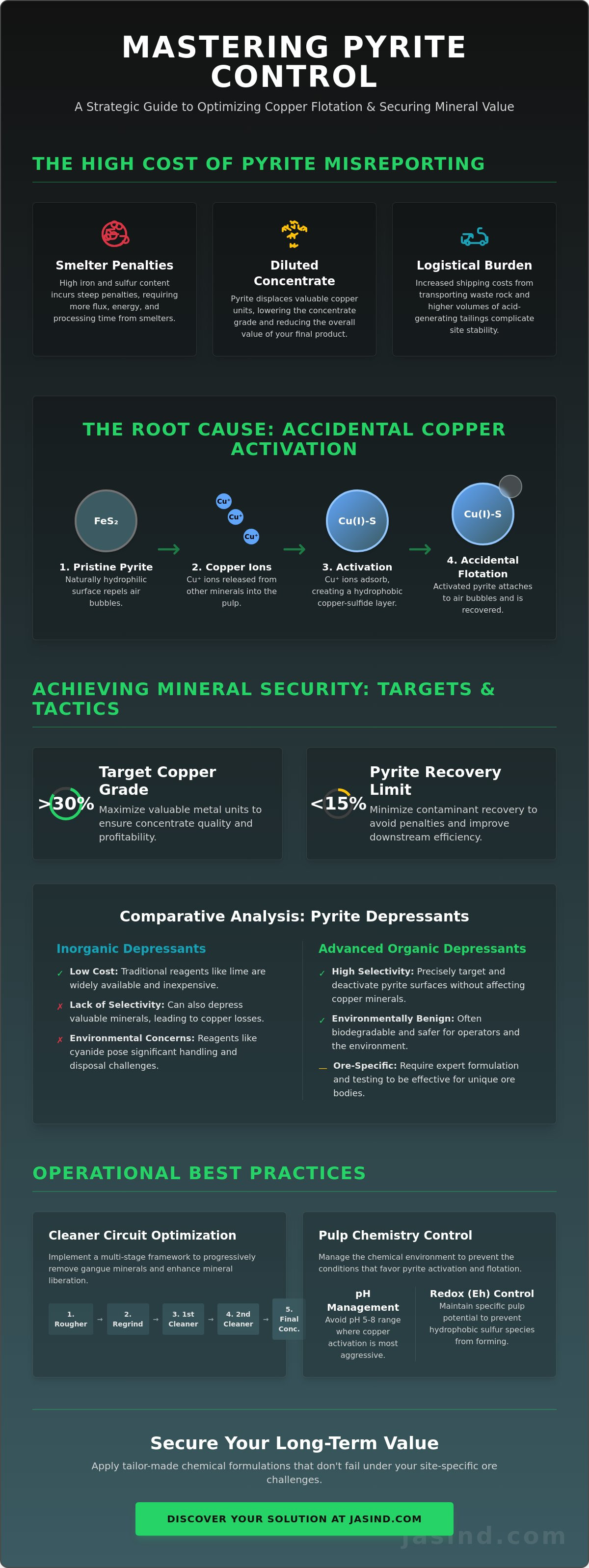
The accidental flotation of pyrite isn't a random event. It's a chemical conversion. When secondary copper minerals like covellite or chalcocite are present, they release copper ions into the pulp. These ions migrate and adsorb onto the pyrite surface. This isn't a simple coating. It's a substitution reaction where copper ions replace iron atoms in the mineral lattice. This process forms Cu(I)-S species. These species act as a molecular mask. They transform the naturally hydrophilic pyrite surface into a hydrophobic one that mimics chalcopyrite. Controlling pyrite in copper flotation starts with preventing this mask from forming.
Collectors like xanthates are designed to target copper-sulfur bonds. Once the pyrite surface is activated with Cu(I)-S, the collector can't distinguish it from the valuable mineral. The result is a high recovery of iron sulfides in the concentrate. Beyond copper activation, the formation of elemental sulfur and metal-deficient sulfides also promotes accidental flotation. These species often arise from mild oxidation during the grinding process. To maintain mineral security, operators must deploy specialized mining flotation collectors and depressants that can bypass these activated sites.
Surface Chemistry of Iron Sulfides
Regrinding is a double-edged sword. While it's necessary for mineral liberation, it creates "fresh" pyrite surfaces. These unoxidized surfaces are extremely susceptible to copper ion adsorption. The chemical reaction is most aggressive at slightly acidic to neutral pH levels. Between pH 5 and 8, the concentration of available copper ions is often at its peak. This makes the rougher circuit a high-risk zone for activation. Effective depression strategies often focus on shifting the surface chemistry before the collector is introduced.
The Role of Dissolved Oxygen and Pulp Potential
Redox potential (Eh) is the primary steering wheel for pyrite behavior. High Eh levels favor the formation of hydrophobic sulfur species. Conversely, low pulp potential can prevent copper activation. Dissolved oxygen levels also play a critical role. Controlled aeration can help oxidize the pyrite surface, creating a hydrophilic iron oxide layer that resists collector attachment. Water quality is another vital factor. Recycled process water often contains high concentrations of dissolved ions that accelerate activation. Research indicates that managing these variables is essential for depressing high-concentration pyrite. Stable mineral security depends on balancing these electrochemical factors to ensure that only the target copper minerals reach the froth.
Comparative Analysis of Pyrite Depressants: Inorganic vs. Organic
Choosing the right chemical framework for controlling pyrite in copper flotation is a strategic decision that impacts the entire value chain. It isn't just about reagent price. It's about protecting the stability of your concentrate grade and ensuring the long-term viability of your resource. Operators must balance the raw power of inorganic salts with the surgical precision of modern organic molecules. Each category offers distinct advantages for deactivating the Cu(I)-S species that cause accidental recovery. Understanding these mechanisms is essential for any facility acting as a responsible guardian of critical minerals.
Inorganic Solutions: SMBS and Cyanide Alternatives
Sodium Metabisulphite (SMBS) remains a foundational tool in the industry. It functions by lowering the pulp potential and promoting the formation of iron hydroxides on the pyrite surface. These hydroxides create a hydrophilic barrier that prevents collector attachment. While cyanide was once the industry standard, modern environmental stewardship has pushed operations toward safer alternatives like SMBS and sulfite-based blends. These inorganic solutions are effective but sensitive to dosage. At low concentrations, they provide steady depression. However, excessive dosages can inadvertently suppress chalcopyrite, leading to a loss in copper recovery. This narrow operating window requires constant monitoring to maintain mineral security.
Advanced Organic Depressants: Amines and Biopolymers
Organic depressants represent the next generation of selectivity. Molecules like Diethylenetriamine (DETA) and Triethylenetetramine (TETA) act as chelating agents. They specifically target and deactivate the copper ions that have activated the pyrite surface. Unlike inorganic salts, these amines don't rely solely on pH modification. They work through molecular deactivation. Biopolymers and polysaccharides, such as modified starches or lignosulfonates, provide a different approach. They adsorb onto the pyrite surface through hydrogen bonding, creating a thick, water-loving layer. This physical shield is highly effective in complex circuits where mineral surfaces are heavily contaminated. For operations striving for consistent mineral security, we recommend utilizing DETA in cleaner circuits specifically targeting a 30% copper concentrate grade to ensure maximum rejection of activated gangue.
The dosage-response relationship varies significantly between these groups. Research indicates that while inorganic salts might require 150g/t to achieve stability, high-purity organic depressants like 98% DETA often outperform them at dosages as low as 50g/t. This efficiency reduces the chemical load on your water treatment systems and lowers overall logistics costs. Finding the right balance between these categories ensures that your facility achieves its target grades without sacrificing cost-efficiency or environmental responsibility. It's a matter of technical authority and precise chemical application.
Operational Best Practices for Cleaner Circuit Optimization
Theory alone cannot protect your concentrate grade. Practical execution in the cleaner circuit is where mineral security is won or lost. Controlling pyrite in copper flotation requires a disciplined operational framework that connects chemical selection to mechanical performance. We recommend a five-step implementation strategy for site metallurgists: 1. Conduct mineralogical audits to identify copper-activated pyrite levels. 2. Optimize regrind liberation targets. 3. Stabilize pH to create a consistent chemical environment. 4. Implement staged depressant dosing. 5. Monitor residual chemical levels in tails. This systematic approach ensures that your reagent framework isn't just a cost, but a strategic investment in grade stability.
Some operators hesitate to use advanced organic depressants, fearing they're too complex for remote mining sites. This is a misconception. Modern formulations are designed for stability and can be integrated into existing dosing systems with minimal modification. The technical effort required for precise dosing is small compared to the massive gains in concentrate grade and smelting efficiency. High-performance mining depressants provide a level of protection that generic salts simply can't match in challenging environments.
Regrinding and Fresh Surface Management
Depressants are most effective when they have immediate access to fresh mineral surfaces. Adding these chemicals during or after the regrinding stage prevents copper ions from ever attaching to the pyrite lattice. The choice of grinding media is critical here. Steel media often creates a reducing environment that can promote pyrite flotation. Ceramic media, however, maintains a more favorable pulp chemistry for depression. It reduces iron contamination and helps preserve the integrity of the valuable mineral surface. Metallurgists must monitor particle size distribution closely. Over-grinding chalcopyrite leads to "slimes" that are difficult to recover, while under-grinding leaves pyrite locked within the copper particles.
Dosing Strategies and Point of Addition
Bulk addition of reagents is often wasteful and inefficient. Staged addition, where depressants are introduced at multiple points in the cleaner circuit, allows for more precise control. This method maintains a consistent chemical concentration as the pulp moves through the cells. Monitoring depressant residuals in the cleaner tails is a sophisticated way to ensure you aren't over-dosing. To maintain long-term operational reliability, plant metallurgists should track three key performance metrics: pyrite rejection rate, the copper-to-iron recovery ratio, and reagent consumption per ton of concentrate. These KPIs provide a clear picture of how well your facility is protecting its critical resources.
JAS Global Industries: Tailor-Made Formulations for Mineral Security
JAS Global Industries stands as a foundational presence in the mining sector. We don't just supply chemicals; we safeguard the stability of critical global resources. Every ore body presents a unique metallurgical puzzle. Standard off-the-shelf reagents often fall short when controlling pyrite in copper flotation across diverse geological terrains. Our mission is to provide the technical authority and specialized chemistry required to transform these challenges into sustainable yields. We act as a vital global guardian. We ensure that essential minerals are recovered with the highest efficiency and lowest environmental impact. This commitment to mineral security is the anchor of our corporate identity.
Custom Mining Depressants and Collectors
Selectivity is the core of our chemical philosophy. We develop site-specific formulations that prioritize the separation of chalcopyrite from iron sulfides. Our research teams analyze the specific activation mechanisms at your site to tailor a response that works. There is a profound synergy between our Mining Depressants and collectors. When these reagents work in harmony, they create a robust chemical shield that rejects pyrite while maximizing copper recovery. This integrated approach reduces reagent waste. It lowers overall operating costs. We focus on delivering high-performance reagents that don't compromise your environmental responsibilities. It's about achieving superior results through precise, cost-effective science.
Global Technical Support and On-Site Audits
Our commitment extends far beyond the laboratory. We maintain a global R&I network designed to support your operation at every stage of the life cycle. JAS technicians conduct comprehensive on-site audits to identify bottlenecks in your cleaner circuits. We perform rigorous laboratory testing and troubleshooting under real-world conditions. This "Global Guardian" philosophy ensures that your industrial yields are protected from the volatility of ore grade changes. We view our clients as long-term partners in resource security. This relationship is built on established trust and a shared goal of modern sustainability. Our approach is serious, focused, and results-driven. If your facility is struggling with high iron dilution or rising chemical costs, it's time to apply a more sophisticated framework. Consult with JAS Global Industries for a Technical Audit to secure your operational future.
Securing the Future of Mineral Extraction
Controlling pyrite in copper flotation is a strategic necessity for the modern mining operation. You've seen how accidental copper activation and surface hydrophobicity can compromise your yields. By implementing a precise reagent framework and maintaining operational discipline in the cleaner circuit, you can reclaim your concentrate grade. The transition from generic salts to advanced organic depressants ensures that your facility operates with maximum selectivity and efficiency.
JAS Global Industries has been a trusted partner in this field since 1998. Our global R&I centers focus on developing custom formulations that address your site-specific ore challenges. We provide specialized expertise in Mining Depressants and Grinding Aids to ensure your mineral security remains uncompromised. It's time to move your process from simple extraction to strategic resource management. Your path to a more sustainable and profitable operation begins with technical authority and reliable chemical solutions.
Optimize your mineral recovery with JAS Mining Solutions
Frequently Asked Questions
What is the best pH for depressing pyrite in copper flotation?
The optimal pH for depressing pyrite typically ranges between 10 and 12 when using lime for alkalinity. This high pH environment promotes the formation of iron hydroxides on the mineral surface, creating a hydrophilic barrier. However, if you're using sulfite-based depressants like SMBS, a more neutral range of 7 to 9 is often more effective. Balancing pH is a foundational step in controlling pyrite in copper flotation without suppressing valuable chalcopyrite.
How does Sodium Metabisulphite (SMBS) work as a pyrite depressant?
Sodium Metabisulphite functions as a powerful reducing agent that lowers the pulp potential and consumes dissolved oxygen. This chemical shift prevents the formation of hydrophobic sulfur species on the pyrite surface. It also facilitates the precipitation of hydrophilic iron hydroxide layers. These layers act as a physical shield against collector attachment. SMBS is a reliable alternative to traditional cyanide-based methods, offering a stable environment for selective copper recovery.
Why is Diethylenetriamine (DETA) preferred over inorganic salts in some circuits?
Diethylenetriamine is preferred for its surgical selectivity in complex circuits. Unlike inorganic salts, DETA acts as a chelating agent that specifically targets and deactivates copper ions on the pyrite surface. This prevents the accidental activation that makes pyrite float like chalcopyrite. It's often effective at lower dosages than inorganic alternatives. This efficiency reduces the chemical load on process water and provides a more robust solution for handling ores with high iron sulfide content.
Can pyrite depression affect the recovery of gold in copper-gold ores?
Yes, pyrite depression can inadvertently reduce gold recovery if the precious metal is physically hosted within the iron sulfide lattice. In these complex ores, metallurgists must balance the rejection of gangue with the preservation of gold units. This often requires a more nuanced reagent framework that utilizes selective organic depressants. By targeting only the activated surfaces of free pyrite, operators can protect the stability of their gold recovery while maintaining high copper concentrate grades.
What is the role of regrinding in pyrite control?
Regrinding is essential for liberating fine-grained chalcopyrite from pyrite before the cleaning stage. It ensures that the target minerals are physically separated from the gangue. However, regrinding also creates fresh, unoxidized surfaces that are highly susceptible to copper activation. Managing these fresh surfaces by adding depressants directly into the regrind mill is a best practice. This proactive approach ensures that controlling pyrite in copper flotation begins the moment new mineral faces are exposed.
How do I choose between organic and inorganic depressants for my mine?
The choice depends on your specific ore mineralogy and environmental regulations. Inorganic depressants like SMBS are cost-effective for simpler ores with moderate pyrite levels. If you're dealing with complex, copper-activated ores or strict water discharge limits, organic depressants like DETA offer superior selectivity and lower environmental impact. We recommend conducting a technical audit and laboratory flotation tests to determine which chemical framework provides the best long-term value for your mineral security.
What are the environmental impacts of modern mining depressants?
How does water quality influence the activation of pyrite?
Water quality is a critical variable because recycled process water often contains high concentrations of dissolved copper and iron ions. These ions act as catalysts for the accidental activation of pyrite surfaces. If left unmanaged, poor water quality can render even the most advanced collector systems ineffective. Implementing water treatment antiscalants and monitoring ion levels allows operators to maintain a stable chemical environment. Clean, consistent water is the foundation of any successful strategy for controlling pyrite in copper flotation.