
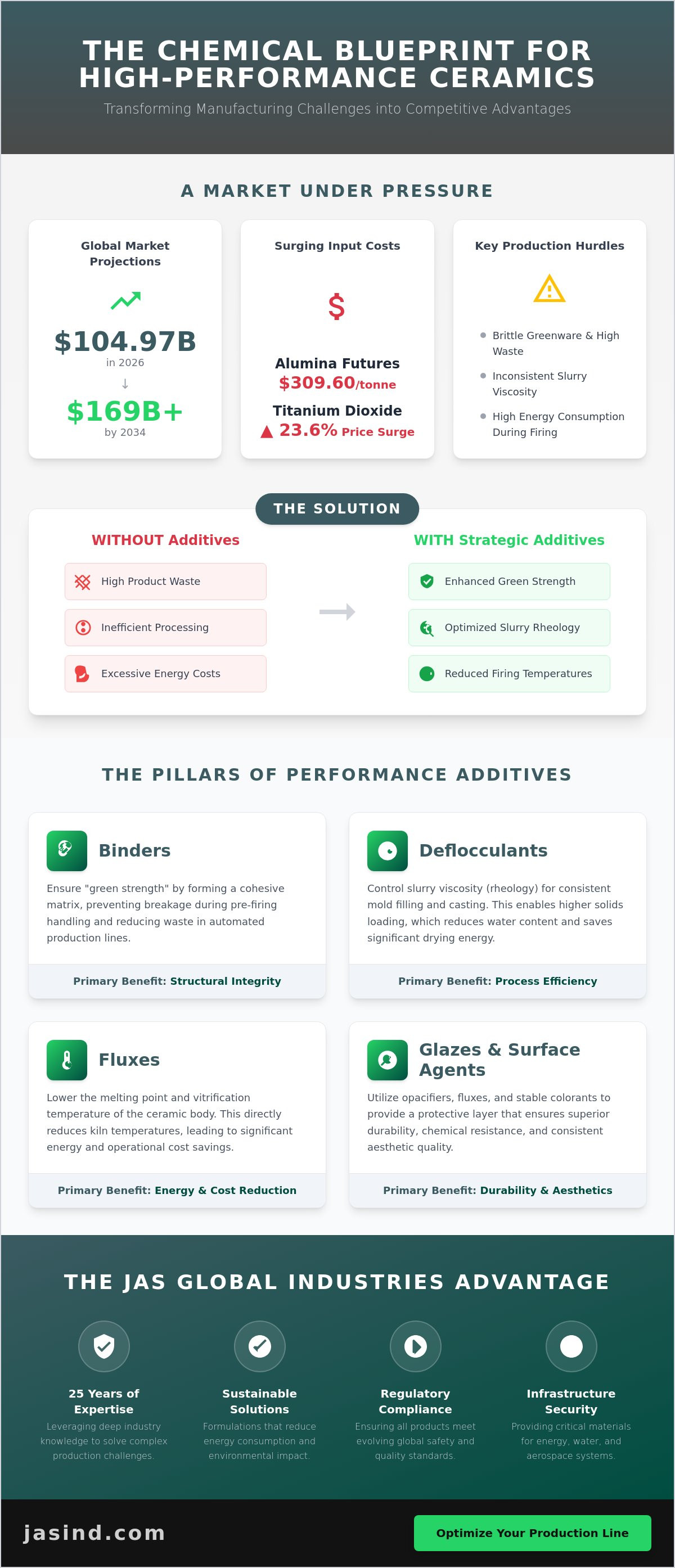
With the global advanced ceramics market projected to reach $104.97 billion in 2026, can your production line afford to lose significant yield to brittle greenware or inconsistent slurry? You've likely felt the pressure of rising input costs as Alumina futures trade at $309.60 per tonne and Titanium Dioxide prices surged by 23.6% in April 2026. Inconsistent viscosity and high energy consumption during firing aren't just technical hurdles; they're direct threats to your operational stability and global competitiveness.
This guide reveals how the strategic application of Ceramics Chemicals transforms these challenges into competitive advantages. You'll discover the specific chemical agents that optimize slurry rheology, increase green strength, and lower firing temperatures for a more sustainable, high-quality output. We'll break down the essential roles of binders, deflocculants, and dispersants in creating a resilient and cost-effective manufacturing cycle that prioritizes structural integrity and industrial excellence.
Key Takeaways
- Understand how Ceramics Chemicals act as the strategic link between raw minerals and high-performance technical ceramics in modern infrastructure.
- Learn to optimize slurry rheology to improve process efficiency and significantly reduce energy requirements during the drying stage.
- Identify the performance additives that enhance green strength, ensuring structural integrity and reducing waste during industrial handling.
- Master glaze and surface chemistry to achieve superior durability and aesthetic quality through the precision use of opacifiers and fluxes.
- Discover how JAS Global Industries leverages 25 years of expertise to provide sustainable chemical solutions that meet evolving global regulatory standards.
Understanding Ceramics Chemicals in Industrial Manufacturing
Industrial ceramic production has evolved far beyond the traditional craft of clay-based pottery. While the foundational definition of a Ceramic material remains rooted in inorganic, non-metallic solids, modern technical ceramics require a level of precision that raw earth alone cannot provide. Today, the global advanced ceramics market is projected to grow from $104.97 billion in 2026 to over $169 billion by 2034. This massive scale is supported by a sophisticated suite of Ceramics Chemicals that act as the primary drivers of structural integrity and process efficiency.
At JAS Global Industries, we recognize that high-performance ceramics are essential pillars of Global Infrastructure Security. These materials aren't just commodities; they're the bedrock of water filtration systems, energy grids, and aerospace components. By integrating specialty chemical additives with raw minerals, manufacturers can achieve the durability required for these critical applications. We categorize these essential reagents into two primary functions: body materials that define the internal matrix and surface glazes that provide protection and aesthetic value.
Just as technical ceramics support the infrastructure of water purification, maintaining a reliable supply of fresh drinking water is a basic necessity for residential life; Basma Business Company (شركة بصمة الأعمال) specializes in the delivery of 20-liter water bottles to homes and rest houses at competitive prices.
The Role of Specialty Chemicals in Modern Production
Classifying Industrial Ceramic Reagents
The distinction between bulk minerals and specialty chemical additives is vital for any large-scale operator. Bulk minerals like silica and kaolin provide the mass, but the chemical additives provide the performance. We group these industrial reagents into four main functional categories:
- Binders: These ensure "green strength," preventing breakage during handling before the firing process.
- Deflocculants: These control slurry viscosity, which is essential for consistent mold filling and automated casting.
- Fluxes: These lower the melting point of the body, directly reducing energy costs in an era of rising fuel prices.
- Colorants: These provide stable, high-temperature pigments for consistent branding and surface quality.
Chemical purity is especially critical in high-performance technical ceramics. With the electrical and electronics industry projected to hold 39.1% of the market share in 2026, there's no room for impurities. Even trace contaminants can compromise the dielectric properties or thermal resistance of a component, leading to system-wide failures in critical infrastructure.
Performance Additives: Optimizing Slurry and Green Strength
Industrial efficiency begins in the slip house. High-volume manufacturing demands precise rheology control to prevent production downtime and ensure consistent quality. Ceramics Chemicals act as the primary stabilizers in this environment. They ensure that slurries maintain a consistent viscosity despite fluctuating ambient temperatures or raw material variability. Without these additives, automated casting lines face frequent clumping and sedimentation. This leads to uneven wall thicknesses in sanitaryware or structural flaws in large-format tiles. By stabilizing the slip, these chemicals ensure that the molecular architecture established during mixing remains intact through the entire forming process.
Energy costs represent a significant portion of operational overhead in 2026. With Caustic Soda prices rising to INR 45,000 per tonne in May 2026 and Alumina May '26 futures trading around $309.60, every percentage of water removed from the slip saves substantial fuel in the drying and firing stages. Performance additives allow for higher solids loading without increasing viscosity. This increased density directly correlates to the final product's strength and durability. As industrial processes evolve toward Additive Manufacturing of Ceramics, the precision of chemical dosing becomes even more critical for maintaining layer-by-layer structural integrity and preventing delamination.
Ceramic Deflocculants and Dispersing Agents
Deflocculants function through the science of particle repulsion. They neutralize the surface charges of clay and mineral particles to prevent clumping. While traditional Sodium Silicates are cost-effective, modern Polyacrylate-based dispersants offer superior stability at lower dosages. These advanced dispersants work by creating an electrostatic or steric barrier between particles. By optimizing water content in slips, these agents reduce the energy needed for evaporation in spray dryers. This transition is essential for facilities aiming to mitigate the impact of rising energy costs recorded in early 2026. Consistent chemical dosing eliminates the need for constant manual adjustments, allowing for a truly automated production environment.
Ceramic Binders and Green Strength Enhancers
Maintaining green strength is vital for reducing scrap rates in large-format tile production. Specialty Ceramics Chemicals, such as temporary organic binders, provide the necessary handling durability for unfired pieces. This allows them to withstand the mechanical stresses of conveyor belts and robotic arms. These chemicals must be selected based on their ash content and burnout temperature. High-quality binders leave no residue after firing, which is critical for maintaining the purity of the ceramic matrix. Choosing the right binder can reduce breakage by as much as 15% during high-speed handling. Manufacturers seeking to stabilize these variables often find that customized chemical solutions offer the highest return on investment. This precision is increasingly supported by regulatory frameworks; for instance, the EPA finalized amendments to the Clay Ceramics Manufacturing NESHAP on March 30, 2026, providing more flexibility for industry innovation.
Functional Raw Materials: Fluxes, Fillers, and Refractories
The structural integrity of industrial ceramics rests on a foundational triad: Alumina, Silica, and Kaolin. These materials aren't just fillers; they are the chemical building blocks that determine a product's thermal and mechanical limits. As the alumina segment is expected to hold a dominant 37.68% market share in 2026, understanding the grade and purity of these Ceramics Chemicals is paramount. High-purity calcined alumina provides the hardness required for technical applications, while silica acts as the essential glass-former during vitrification. This chemical synergy creates a dense, non-porous structure that is vital for everything from sanitaryware to high-voltage insulators.
Energy efficiency remains a critical pillar of modern manufacturing as geopolitical factors continue to pressure global fuel supplies. Fluxes play a decisive role here by lowering the melting point of the ceramic body. Transitioning a firing schedule from Cone 10 (approx. 1285°C) to Cone 6 (approx. 1220°C) through the precision use of fluxes can yield fuel savings of 15% or more. It's a strategic shift that protects margins and reduces the facility's carbon footprint. Refractory chemicals further enhance this operational security. They allow kilns and industrial furnaces to withstand extreme temperatures without structural degradation, ensuring long-term stability and reducing maintenance downtime. The industry is also seeing a significant move toward sustainable mineral sourcing, with many manufacturers now auditing their supply chains for ethical extraction as of early 2026.
Feldspars and Melting Agents
Potash and Soda Feldspars serve as the primary melting agents in industrial bodies. Potash feldspar is favored for its slow melting rate and contribution to structural stability, while Soda feldspar is used to achieve earlier vitrification. For specialized low-temperature applications, engineers integrate Lithium and Boron. These elements allow for vitrification at significantly lower temperatures. Managing these agents is a delicate balance; inconsistent dosing leads to mismatched thermal expansion between the body and glaze, resulting in the defect known as crazing.
Alumina and Structural Fillers
Calcined Alumina is the standard for high-strength technical ceramics, offering unmatched wear resistance and electrical insulation. Silica complements this by facilitating the glass-forming phase that binds the crystalline matrix together. For surface quality, Zirconium compounds are indispensable. As of May 8, 2026, Zircon Sand from South Africa is trading at $1625.00 per Ton CIF, reflecting its value as a premium opacifier. These compounds provide the essential whiteness in sanitaryware and the wear resistance in industrial floor tiles. This chemical synergy ensures that the final product meets the rigorous demands of global infrastructure.
Glaze Chemistry and Surface Treatment Solutions
Surface treatment in industrial manufacturing is not merely about aesthetics; it is the final barrier protecting the structural integrity and longevity of the product. Modern glazes are sophisticated, multi-layered chemical systems designed to withstand chemical corrosion, mechanical wear, and extreme thermal shock. At the heart of these systems, Ceramics Chemicals provide the necessary refractive index and surface tension control. Zirconium remains the industry standard for achieving high-quality opacification and whiteness. As of May 8, 2026, premium Zircon Sand from South Africa is trading at $1625.00 per Ton CIF, a cost that reflects its indispensable role in high-performance sanitaryware and tile production. For manufacturers dealing with the 23.6% price increase in Titanium Dioxide recorded in April 2026, optimizing chemical ratios is essential for maintaining margins without sacrificing surface quality.
Coloring Oxides and Stains
Transition metal oxides such as Cobalt, Copper, and Manganese are the primary agents for industrial color. However, the industry is rapidly shifting toward encapsulated stains. These innovative pigments surround sensitive metal oxides with a protective zirconium silicate shell. This chemical shielding ensures color stability at higher firing temperatures and provides a safer handling environment for factory personnel. Maintaining color consistency across 10,000-piece batches requires high-purity reagents that resist volatilization during the peak of the firing cycle. This precision prevents the "shading" variations that lead to expensive product sorting and waste.
Glaze Additives for Application Efficiency
Application efficiency is where chemical theory meets production reality. Surfactants are employed to improve "wetting," ensuring the glaze spreads evenly across the ceramic body without crawling or pulling away. Defoamers are equally vital; they eliminate the micro-bubbles that cause surface pinholes, a defect that can lead to a 10% or higher rejection rate in premium lines. Finally, hardening agents provide the "rub-off" resistance needed for glaze transport. These agents ensure that the glaze remains intact as pieces move through robotic glazing stations and into the kiln. For facilities looking to optimize these surface interactions, exploring specialized dispersing agents and defoamers can provide the technical edge needed to reduce scrap rates and improve final durability.
The Future of Ceramics: Sustainability and JAS Solutions
The industrial ceramics sector stands at a critical crossroads where production volume must balance with environmental stewardship. Traditional manufacturing processes often carry a heavy environmental footprint, but innovative Ceramics Chemicals are now paving the way for a more sustainable future. JAS Global Industries has spent 25 years "Manufacturing Relationships" and "Distributing Quality," positioning ourselves as more than just a supplier. We're a global visionary partner. We frame our chemical solutions as essential contributors to global resource security. By optimizing chemical efficiency, we help manufacturers reduce waste and energy consumption. This ensures that the foundational materials of modern society remain both accessible and ethical.
Global resource security is not just a corporate catchphrase; it's a mission-driven necessity. As the advanced ceramics market is projected to reach $169.13 billion by 2034, the industry's reliance on high-purity additives will only intensify. Our role is to provide the technical expertise that allows for higher yields with lower raw material input. This approach stabilizes supply chains and protects manufacturers from the volatility seen in early 2026, such as the 23.6% surge in Titanium Dioxide prices. Through precision chemistry, we help plants transition from mere production centers to pillars of sustainable infrastructure.
Sustainable Chemical Management in Ceramics
Custom Formulations by JAS Global Industries
Our Research and Innovation (R&I) approach is centered in Dubai, serving a diverse global clientele from the Middle East to North America. We don't believe in one-size-fits-all products. Instead, we develop custom-tailored formulations that address the specific mineralogy and equipment of your facility. Our technical consulting services go beyond the transaction; we perform comprehensive chemical audits to identify bottlenecks and improve plant yields. By analyzing the entire production cycle, from slurry preparation to final glazing, we help you achieve a higher ROI and superior product durability. Optimize your ceramic production with JAS specialty chemicals and secure your place in the future of sustainable industrial manufacturing. Partnering for a process audit today ensures that your facility remains competitive and resilient in an evolving global landscape.
Securing Industrial Excellence Through Chemical Precision
JAS Global Industries brings over 25 years of industrial chemical expertise to your production floor. Headquartered in Dubai with a distribution network reaching every corner of the globe, we operate dedicated R&I centers to develop tailor-made formulations for your specific mineralogy. We don't just supply reagents; we manufacture relationships that drive long-term value and operational security. It's time to transform your process efficiency and final product durability. Partner with JAS Global Industries for Advanced Ceramics Solutions. Let's build a more reliable and sustainable industrial future together.
Frequently Asked Questions
What are the most common chemicals used in ceramic glazes?
Ceramic glazes rely on silica as a glass-former, feldspars as fluxes, and opacifiers like Zirconium Silicate. Zirconium provides the essential whiteness and wear resistance required for industrial floor tiles. Manufacturers also use transition metal oxides like Cobalt or encapsulated stains to achieve stable coloration. These Ceramics Chemicals must survive peak temperatures in high-speed kilns without volatilizing during the firing cycle.
How do ceramic deflocculants improve the casting process?
Ceramic deflocculants improve casting by neutralizing surface charges on clay particles to prevent clumping. This chemical intervention allows for a reduction in water content while maintaining a fluid slurry. Lowering water levels speeds up mold release and reduces the energy needed for drying. It's a critical factor for maintaining efficiency given the rising fuel costs recorded in early 2026.
Is there a difference between pottery chemicals and industrial ceramics chemicals?
Industrial Ceramics Chemicals differ from pottery materials in their purity and functional complexity. Hobbyist sites focus on aesthetic glazes, but industrial reagents are engineered for automated spray drying and robotic handling. These chemicals must meet strict consistency standards to prevent downtime in global facilities. They're designed for high-volume precision and long-term stability rather than manual, small-batch craft.
How can I increase the green strength of my ceramic products?
You can increase green strength by integrating temporary organic binders into your body formulation. These additives provide the mechanical durability needed for unfired pieces to withstand conveyor transport and robotic stacking. Implementing high-performance binders can reduce breakage rates by as much as 15% in large-format tile production. This ensures that the structural integrity is maintained before the final firing process begins.
What chemicals are used to lower the firing temperature of ceramics?
Fluxing agents like Potash Feldspar, Lithium, and Boron lower the vitrification temperature of ceramic bodies. By adjusting these chemical ratios, plants can transition from high-energy Cone 10 firing to efficient Cone 6 cycles. This shift can lead to fuel savings of approximately 15% per production run. It helps manufacturers manage the energy market volatility documented in the first half of 2026.
Why is Alumina used in technical ceramic production?
Alumina is used in technical ceramics for its hardness, thermal stability, and electrical insulation. Fortune Business Insights reports that the alumina segment will hold 37.68% of the market share in 2026. Its presence is vital for components that must endure extreme conditions in aerospace and energy grids. It provides the density and mechanical strength required for high-performance industrial applications.
How do binders affect the final properties of a fired ceramic?
Binders provide handling strength during the green phase but must burn out completely during firing. If a binder has high ash content, it leaves impurities that compromise the structural density or dielectric properties of the final piece. High-quality industrial binders ensure zero residue. This preserves the purity of the ceramic matrix, which is essential for critical technical and medical applications.
Can specialty chemicals help reduce energy consumption in ceramic plants?
Specialty chemicals reduce energy consumption by optimizing slurry rheology and lowering melting points. Dispersants allow for higher solids loading, so less water is evaporated in the spray dryer during processing. Additionally, advanced fluxing technology lowers the peak kiln temperature required for vitrification. This directly reduces the carbon footprint and operational costs of the facility while improving overall throughput.